


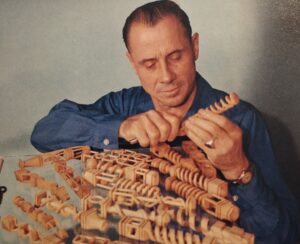
“To produce any of these fascinating pieces, the whittler needed only a piece of wood, his pocketknife and a sharpening stone. He, the tramp, would then use his pieces to give as a gift to a friend, barter for food, or exchange for money.” (Vandertie & Spielman, 1995)
There is a character in my novel Resolute Death, whom I usually refer to as the “ex-hobo now English professor and poet laureate,” who carves whimsy sticks. If you’re not up on your American Folk Art, you may not know what a whimsy stick is. And even if you are, it’s not an easy art form to find out about.
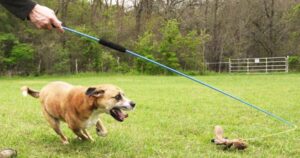 Typically, an information search on the phrase whimsy stick turns up a slew of advertising sites for something referred to as a Whimsy Stick Flirt Pole, a specialized toy for dogs: “Designed by a trainer, the Whimsy Stick was built to support structured instinct fulfillment through purposeful movement, not chaotic play.” [1] [2] Imagine one of those faux fishing poles for cats that have funky toys at the cord’s end to capture the kitty’s attention. The canine version is very like but designed for training.
In terms of art making, a whimsy stick is a type of folk art made by whittling, or carving, a found piece of wood into a narrow, stick-shaped object. It is typically classed as tramp art or hobo art.
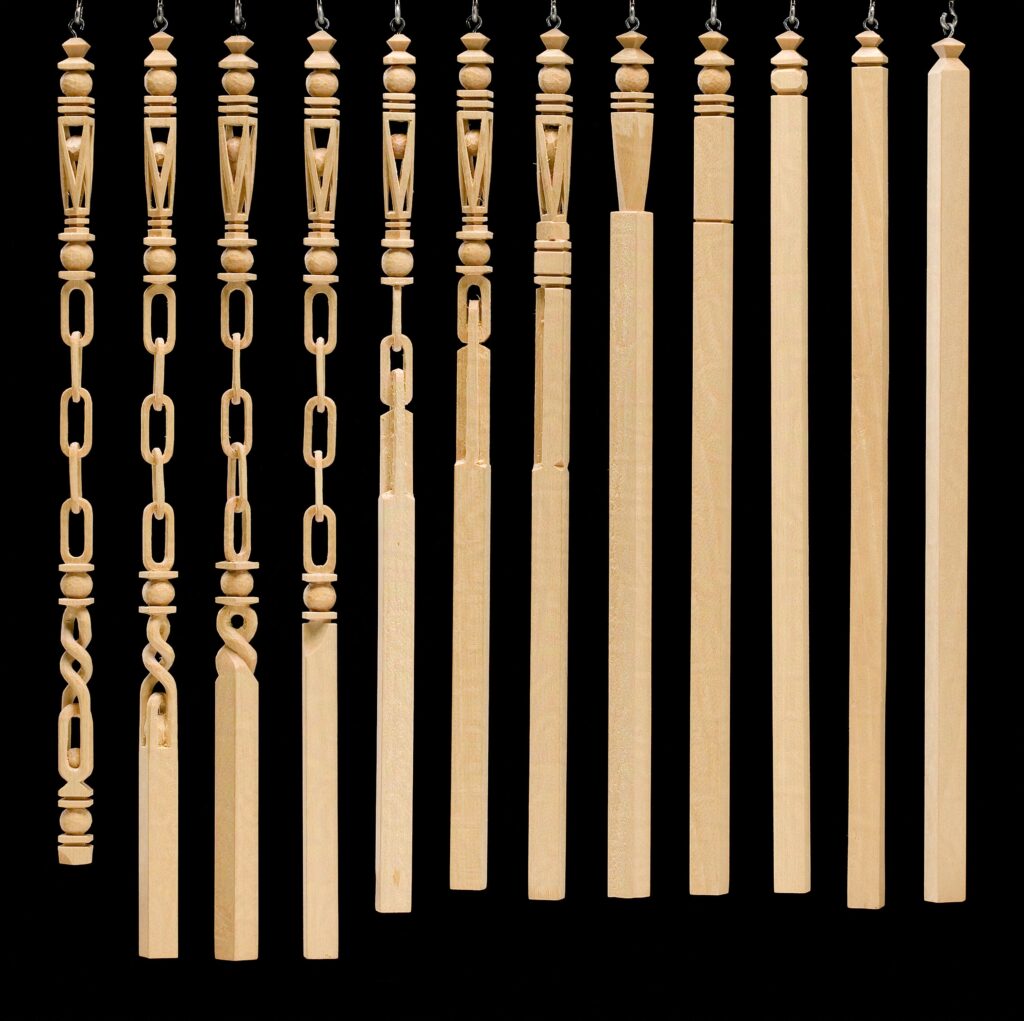
The most typical whimsies are the ball-in-the-cage and chain. In the above image here, an in-process take on the creation of a whimsy stick, we see both. At the top is a small ball-in-the-cage. The chain, below that, is a series of interlocking links. [3]
In both cases, the shapes are carved into a single piece of wood; the ball is loose in its cage, the chain begins as a single section that is gradually carved out into its separate links. Other decorative elements such as spirals, small spheres, loops, and small open box-shapes can be added by the carver.
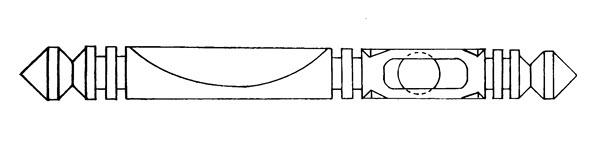
Lesser known designs are the fidget stick (below), a hand-sized creation with a concave surface on the one side that one rubs one’s thumb along as a way of calming one’s stress, and the neckerchief slide. The slide is used to secure the front ends of a red bandanna to keep the scarf in place.
The best known whittler of whimsy sticks is Adolph Vandertie (1911–2007). In the exhibition brochure for Good Road to Follow, the 2020-2021 installation at the John Michael Kohler Arts Center, Vandertie describes where he learned the craft:
“The obsession I have toward the hobby of whittling and collecting hobo and tramp art began as a young boy when I made frequent trips to the hobo jungles where I listened, wide-eyed, to the stories told by the hoboes of the faraway places they had been and the many adventures they had experienced. . . . It was in this environment that I experienced the eating of Mulligan stew and the whittling of what has become the trademark of the whittler: the ball-in-the-cage.” [4]
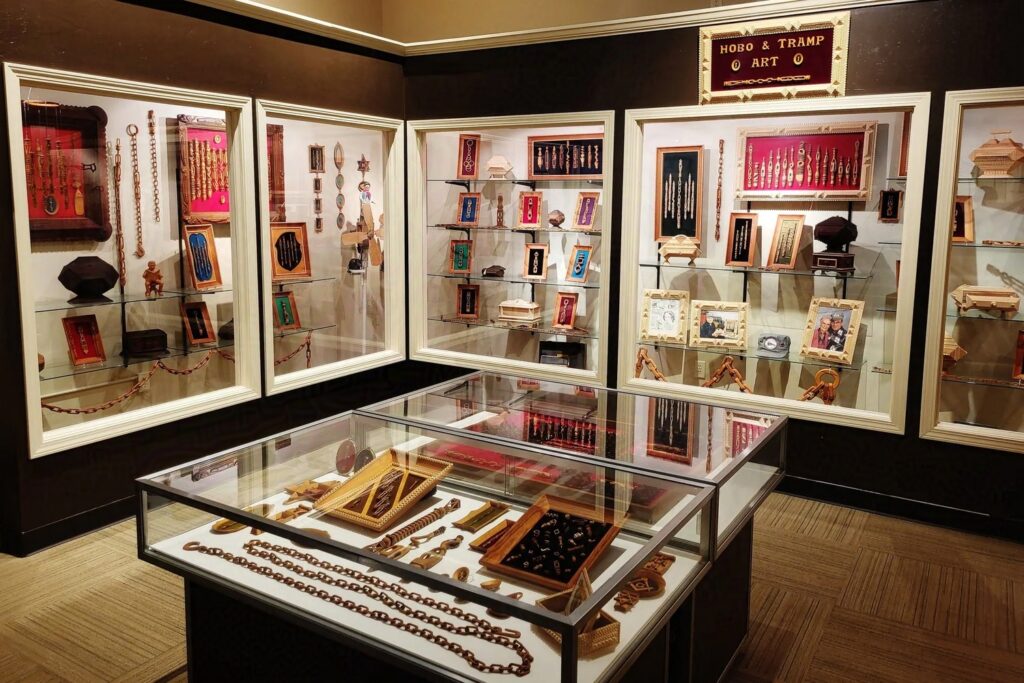
He went on to collect and whittle “a great many of these artifacts of whittlers’ art, estimated in excess of 2,000 pieces.” The Ashwaubenon Historical Museum in Green Bay, WI has a permanent display of his collection (see above). In her 2009 aricle in JSOnline, the local newspaper for Milwaukee, WI, Mary Louise Schumacher spoke effusively of the artist:
“The volume of work and the sheer skill at finessing wood is overwhelming and a testament to Vandertie’s perseverance and vision.” [5]
Whimsy sticks have been described by some as tramp art though not all experts agree. Laura A. Addison, in her introduction to her edited work No Idle Hands, initially states that “Tramp art has often been a contested effort…characterized by V-shaped notching along the edges of thin pieces of wood that are then layered in such a way that the wood sheets become progressively smaller.” [6, pg. 12] A whimsy stick has no such layering and is restricted to working one piece of wood. The technical enchantment of it is just that: a single work of art is made from a single piece of wood, with no attachments. The whittling of it must be carefully designed and executed.
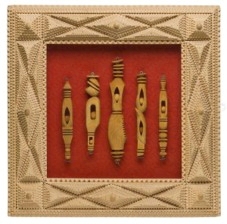 This image here, a set of whimsy sticks “with their supple curves and abstract shapes” was carved by Vandertie.The frame is an example of chipped, layering tramp art. These particular whimsies are an example of the more elaborate and delicate carving possible by an experienced whittler.
Vandertie, along with Patrick Spielman, wrote what may be the definitive book on whimsy sticks: Hobo & Tramp Art Carving: An Authentic American Folk Tradition (1995). In contains more images of whimsies than I have seen in any other book. They also include several how-to sections, though very basic.
Vandertie and Spielman’s book has how-to images, but they may be difficult for a beginning carver to work out in actual practice. I found some useful videos over on YouTube. It’s a slow art and the quality of the carving varies.
How-To Info
“Ball in a Box.” By Bob Young. Via Pinterest. [A collection of images of whimsy carvings via Pinterest website.]
https://www.pinterest.com/bobyoung41/ball-in-a-box/
“How to Carve a Ball in a Cage Out of Wood.” By rasmus_pf. Via Instructables website.
https://www.instructables.com/How-to-Carve-a-Ball-in-a-Cage-Out-of-Wood/
“How to Make Hobo Art – whimseys, chains, and balls-in-cages.” Via the Folk Artisans website.
https://www.folkartisans.com/sup/howtocrv.html This website also includes a number photos of whimsy sticks from the Vandertie and Spielman book posted by permission of the Sterling Press.
“Shop Talk with Tim” YouTube channel.
-
- How to Whittle a Ball Inside of a Box: https://youtu.be/r4FvND7PJNc
- Whittle With Me – Wooden Chain: https://youtu.be/Vuub3ecjwnI
Tammy McGowan YouTube channel.
-
- How to Carve a Double Ball in a Ball: https://youtu.be/dpQgBXn2Oko
“Whittle Me This” YouTube channel.
-
- Carving a “Ball in Cage” : https://youtu.be/dINJqvGeUHY
“Whittling for Beginners YouTube channel has a multi-part series on whittling a chain and ball-in-cage: https://www.youtube.com/@WSCSSheboygan/search?query=whittling
resources
Books (on hobo & tramp Art as well as the hobo/tramp lifestyle)
Hobo & Tramp Art Carving: An Authentic American Folk Tradition. By Adolph Vandertie with Patrick Spielman. Sterling Publishing, NY (1995). ISBN: 0-8069-3185-X.
The Hobo Handbook: A Field Guide to Living by Your Own Rules. By Josh Mack. Adams Media (2011). ISBN: 978-1440512278.
The Hobo: The Sociology of the Homeless Man. By Nels Anderson. Trad Street Press (2026). ISBN 13: 9781025716923.
A Legacy in Tramp Art. By Clifford A. Wallach. Schiffer (2012). ISBN: 978-0764341069
No Idle Hands: The Myths & Meanings of Tramp Art. Edited by Laura M. Addison, Museum of New Mexico Press (2017). ISBN: 978-0-89013-622-5.
Vagabonds, Tramps, and Hobos: The Literature and Culture of U.S. Transiency, 1890-1940. By Owen Clayton. Cambridge University Press (2023. ISBN: 978-1009348034.
If you have a question or comment for me, drop me a line via my Contact page.
© J.A. Jablonski 2026. All rights reserved.
How to cite this post
Jablonski, J.A. (2026; Oct 24). So, Just What Is a Whimsy Stick? Blog post. J.A. Jablonski (website).
https://jajablonski.com/2026/10/24/whimsy-stick/
IMAGE CREDITS
Adolph Vandertie carving a whimsy stick. From his (and Patrick Spielman’s) book. Citation in Resources section above.
Dog excitedly tracking a capture toy deployed at the end of a flirt toy. Photo from the Healthy Pet Austin website: https://healthypetaustin.com/blogs/news/using-a-flirt-pole-the-right-way-structure-safety-and-purposeful-play
Row of whimsy sticks in process. Adolph Vandertie, untitled, n.d.; wood; 17 3/4 x 16 1/4 x 8 in. John Michael Kohler Arts Center Collection, gift of Kohler Foundation Inc. Photo courtesy of John Michael Kohler Arts Center.
Diagram of a fidget stick. From the Vandertie and Spielman book.
Corner view of the permanent display of Vandertie’s collection at the Ashwaubenon Historical Museum (Green Bay, WI). Photo from the museum’s website: https://www.ashwaubenonmuseum.org/our-exhibits
Wood-framed collection of whimsy sticks, carved by Adolph Vandertie. See [5] below for source citation.
SOURCES | NOTES
[1] “Using a Flirt Pole the Right Way: Structure, Safety, and Purposeful Play.” (5 February, 2026).
https://healthypetaustin.com/blogs/news/using-a-flirt-pole-the-right-way-structure-safety-and-purposeful-play
[2] The Whimsy Stick web site has a number of videos showing the flirt pole in action. https://whimsystick.com/
[3] JMKAC 2021 online exhibition record page for “Good Road to Follow, March 1, 2020 – January 17, 2021.”
https://research.jmkac.org/exhibition/good-road-to-follow/
[4] The complete brochure can be accessed here: https://research.jmkac.org/wp-content/uploads/PDFs/HoboTrampArtBrochure.pdf The Kohler Foundation has an information page on Adolph Vandertie here: https://www.kohlerfoundation.org/preservation/wisconsin-artists/adolph-vandertie/
[5] Schumacher, Mary Louise. (2009, 21 August). “Adolph Vandertie, Grand Duke of the Hobos.” JSOnline archives website. https://archive.jsonline.com/blogs/entertainment/53747732.html
[6] Addison, Laura M, editor. (2017). No Idle Hands: The Myths & Meanings of Tramp Art. Museum of New Mexico Press, Santa Fe.