R.B. Lemberg | The Four Profound Weaves
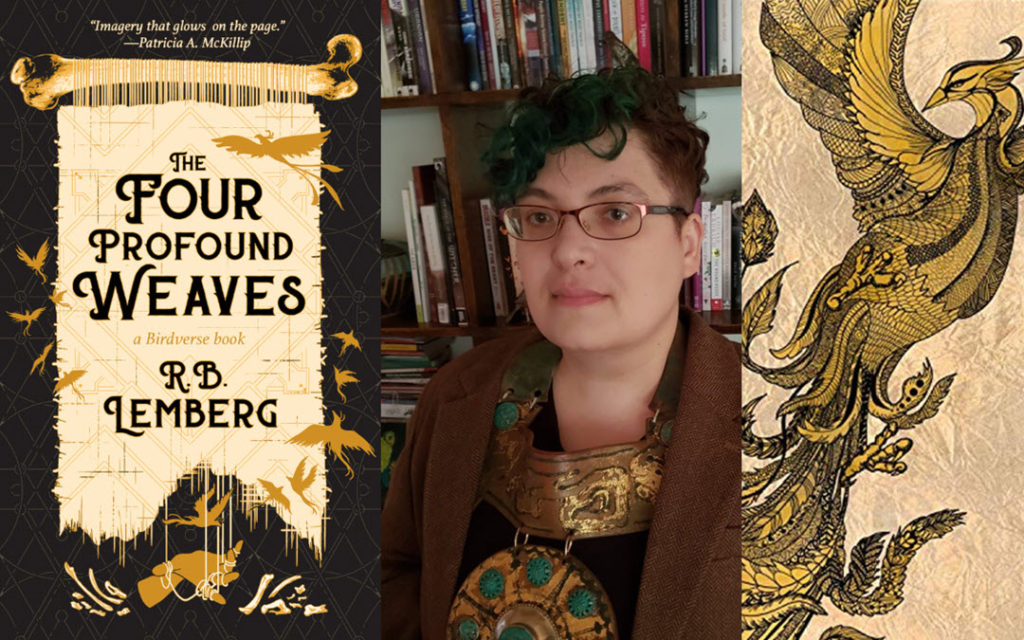
RB Lemberg Four Profound Weaves Book

R.B. Lemberg

“I am in the end . . . a creature of the work, of deep storytelling, and of imagination. In Lemberg’s novella, I find all three. “

When I read R.B. Lemberg’s novella, The Four Profound Weaves (2020.) [1] I expected not to like it but I hoped, very much hoped, that I would.

Reader: I did, very much did.

I expect to not like most things I read. I am something of an impatient reader. It is my private idiosyncrasy. It tends to flare more often when I read fiction. Non-fiction, it seems, just annoys me as it is often a matter of sloppy thinking, bad-writing, incorrect information, etc. (though I draw the line at plagiarism). These are not good things, but I tend to cut a non-fiction writer a little slack. The younger ones anyway. Experienced oldsters should know better and deserve every ounce of flack thrown their way.

Poets get all the slack and all the love from me. Poetry is its own universe. I go there, I write there, and I know that the poet’s mind is the mind of an artist who, as Ursula K. Le Guin noted, goes

“into the gap between . . . . They go limping and weeping, ugly and frightened, and they come back with the wings of the redwing hawk, the eyes of the mountain lion.” [2]

Fiction writers, many of them anyway, are artists too. And I try to temper my readerly temper on their behalf. Writing isn’t an easy craft. I know this. So to come upon a story that takes me into it then lets me walk back into myself and back again, well, it’s a rare work that can create that two-way bridge and make it an easy yet challenging walk.

The Quality of Craft

R.B. Lemberg’s The Four Profound Weaves is such a story. I am a long time reader of Ms. Le Guin. Her work is crafted down to the molecules as writing and to the subatomic in terms of story. One feels utterly held by her. Lemberg’s novella holds a comparable easeful regard of its readers while pushing, pushing that deeply reflective quality one hopes to find in works of imagination. There is world building and there is cosmology. Lemberg has managed to do both and, fittingly, woven them together so that each one is visible, yet not, while informing the other.

I will not summarize the story. Other reviewers have done this better than I could (See Foreword Reviews or Publishers Weekly). My intent is to relay my immediate response as a reader. (I wrote my notes for this post an hour after reading the book.)

For me the heart of a fiction work is character. I want to know the persons almost more than I want to know the plot in which they are encased. So I am sensitive to point of view. As a reader I typically balk at first person narration. It is too easy, I think, for the author to channel themselves. Solid, credible first person point of view is hard to master.

Lemberg does master it, twice, their chapters alternating between two trans “elders,” former/current friends, who travel together on a quest to find the aged aunt of one, a legendary weaver. One, Uiziya, seeks to know how to weave a carpet of bones, the other, nen-sasaïr, the so-called nameless man, to learn their new name. By narrative necessity their tales overlap, but who they each are, who they perceive themselves to be, what their respective “mission” is, what they each hope for, is succinctly delineated. They are different people but their cultures overlap, they have awareness of the other cultures. So it could have happened that Lemberg’s “first persons” could have sounded like one person. They do not. And the characters themselves are vividly rendered in voice, movement, beliefs, history, and emotion/psychology. They are real, which is something quite powerful when the story is not simply fiction, but fantasy fiction.

Opening Lines

Another thing that either catches me or doesn’t are the opening lines of the first chapter. Personally, I hate it when literary agents (on Twitter is where I tend to see this) harp on the importance of opening lines. But they are right for the most part. It’s not simply the content of those sentences, though one hopes they set the tone for the story and, if one is lucky, the whole damn story itself.

The opening two sentences of Four Weaves are “I sat alone in my old goatskin tent. Waiting, like I had for the last forty years, for Aunt Benesret to come back.” I laughed, out loud. For in that split second I recalled the opening lines of three other authors I’d read recently and semi-recently, all trying something similar with varying degrees of—to my eye—success. (Disclaimer: I do not presume that my take is anyone else’s but my own.)

“The steerswoman centered her chart on the table and anchored the corners around. A candlestick, a worn leatherbound book, an empty mug, and her own left hand held the curling parchment flat.” 

“Matt said you find things. For a living,” the woman said on the phone.”

“There was a wall. It did not look important.”

The first is from Rosemary Kirstein’s The Steerswoman, described as a science fantasy novel. It is the first of a series. Established here: who, something of a setting, an overall tone, and that wonderfully curious phrase, “her own left hand.” [3] The opening description was slightly cliché but that single phrase–her own left hand–caught me. It was a quality of character subtlety that intrigued. Going forward, I read the first three books, I was very much intrigued by the tale but the writing kept tripping me. Description overrode things, the “own left hand” turned out to be a phrase quirk and no more. The story got lost in the telling. I didn’t read book four and book five has yet to be completed.

The second is from Kristen Lepionka’s 2017 mystery novel The Last Place You Look. Typical noir in cadence, snarkish tone, and an anonymous caller. [4] I know I probably shouldn’t, but I laugh at that noir verbal tic. I can’t take it seriously. I didn’t get beyond the first chapter. I couldn’t, and I wanted to. But time is precious and I only read what I want to read.

The last is from Le Guin’s SF novel The Dispossessed. The cadence is the same as Lemberg’s opening two sentences. Setting, tone, context nailed in nine words. [5] I have read most of what Le Guin has written, fiction, non-fiction, and poetry. I don’t like everything she’s done but I’ve read it. Not simply because she is a master at the craft of writing and an imagineer, world builder, and cosmologist of the highest level. She exudes the power of a soul sorted, explored, and faced with ruthless honesty. I am drawn to her in a way I am drawn to no other author.
Silhouette of exotic flying bird
A Singular Author

Lemberg does that for me and, frankly, I am floored. I came across them only recently and incidentally, someone I follow on Twitter mentioned them. Perhaps they quoted them, I don’t recall but I was curious. I started to follow them and saw mention made and discussions shared about this new work coming out that had a flavor of originality. I am keen for new stories. There was something else, though, a personal grief, which the nature of Twitter meant it was a public grief. I have been touched by the quality of their expressions and efforts in this deeply mournful time. There was grief, but an ineffable connection with life too.

I typically avoid seeking out the personal about an author. I want their stories, I don’t want them. I believe writers, like everyone, are owed their privacy. That I know what I do about Le Guin is mostly due to the scholarly articles I’ve read about her, the personal remarks she makes in her essays and writing instructionals, and Arwen Curry’s splendid documentary, Worlds of Ursula K. Le Guin. I honored Lemberg’s mourning but did not, as a stranger, want to in any way intrude.

I preordered The Four Profound Weaves and, in awaiting its arrival, did something I never do. I avoided all reviews and all commentary as best I could. I don’t mind spoilers, so it wasn’t that. It seemed to me that this book might be the kind of book that gave my angry reader self a needed calming down. I have never before so prepared myself to read like this. And I am grateful that I was not disappointed.

I am in the end, I guess one might say, a creature of the work, of deep storytelling, and of imagination. In Lemberg’s novella, I find all three. They craft their writing. There is cadence to the sentences, the narrative flow, and the plot itself. They know how language works to deepen the culture surrounding people and their doings. Character names sound real. The words used to describe artifacts, cultural behavior, the sociology of the different peoples all ring true. With regard to the journey that is imagination, Lemberg bends their mind (and heart too, one senses) into that gap between and emerges with the wings of the redwing hawk. This tale seems to have been torn from their soul.

The Four Profound Weaves is an unexpected gift. In Lemberg’s Birdverse context, I am an elder (though I do not feel like one). I have not felt as young as I do now, as a child looking forward to sitting at their feet, awaiting future tales. I am grateful to know that their stories are and will continue to be told after I am no more.

NOTE: This essay is a lightly edited version of one I originally published on 2 Sept 2020 on my blog Dante’s Wardrobe.

© J.A. Jablonski 2021. All rights reserved.

ABOUT BOOK THOUGHTS

“Book Thoughts” is an intermittent column within my blog. The essays are not so much book reviews as a book responses. I like to converse with and around the books I read.  

HOW TO CITE THIS POST

Jablonski, J.A. (2021, Aug 30). R.B. Lemberg | The Four Profound Weaves. Blog post. J.A. Jablonski (website).
https://jajablonski.com/2021/08/30/four-profound-weaves/

IMAGE CREDITS

Cover of The Four Profound Weaves. From Lemberg’s website.

R. B. Lemberg.  Author photo from Lemberg’s Press Kit.

Modified cover image of bird from Audible version of book.

Silhouette of exotic flying bird. From the Tachyon Press page for The Four Profound Weaves.


SOURCES

Disclaimer: As a Bookshop Affiliate (US only) I will earn a commission if you click through on a book title I’ve linked to and make a purchase.

[1] Lemberg, R.B. (2020). The Four Profound Weaves.  Tachyon.

[2] Le Guin, Ursula K. (1985)  Always Coming Home. Harper & Row, pgs: 74-75.
(Bookshop link is to the University of California edition.)

[3] Kirstein, Rosemary. (2019). The Steerswoman. Published by Rosemary Kirstein.

[4] Lepionka, Kristen. (2017). The Last Place You Look. Minotaur.

[5] Le Guin, Ursula K. (1974). The Dispossessed. Avon Books.
(Bookshop link is to the Harper Voyager 1994 edition.)
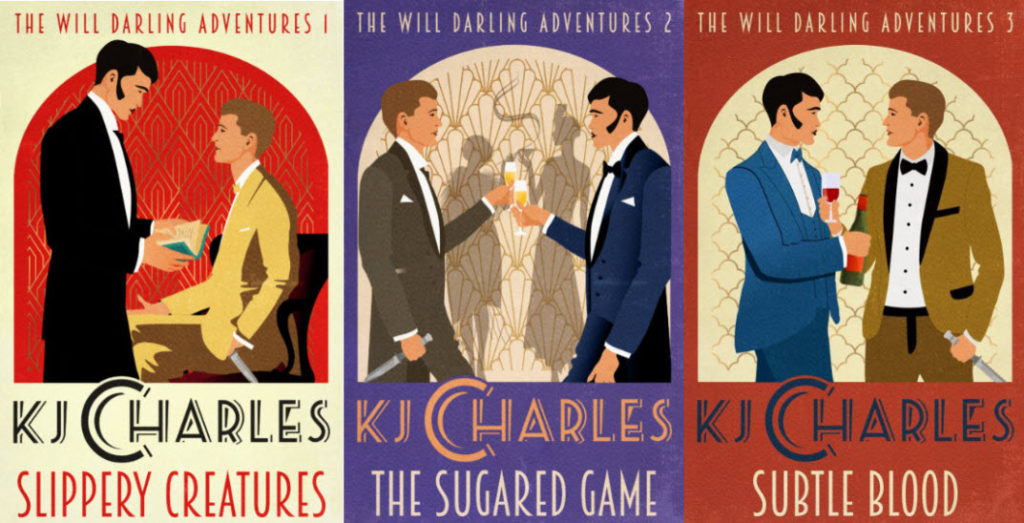
KJ Charles | The Will Darling Adventures | Pt. 2

Covers of KJ Charles books showing Darling & Kim Secretan facing each other
The Will Darling Adventures by K.J. Charles [1]
Cover Art by Tiferet Design


“For all that the Will Darling books are romance, they are not sweetness and light. People have pasts and they hurt as a result.“

KJ Charles reports that writing the final book of The Will Darling Adventures trilogy (Subtle Blood) was especially difficult, describing the experience “like driving [a Land Rover] into a tar pit.” [2] As with many authors writing at that same time, the Covid pandemic laid her low. I, for one, am grateful she persevered. Reading Books 2 and 3 both comforted and kept me reasonably sane in the face of the virus’ impact in my own life.

Series description from Charles’ website:

A m/m romance trilogy in the spirit of Golden Age pulp fiction. It’s the 1920s and tensions are rising along with hemlines. Soldier-turned-bookseller Will Darling finds himself tangled up in spies and secret formulas, clubs and conspiracies, Bolsheviks, blackmail, and Bright Young Things. And dubious aristocrat Lord Arthur ‘Kim’ Secretan is right in the middle of it all: enigmatic, unreliable, and utterly irresistible.

The Sugared Game

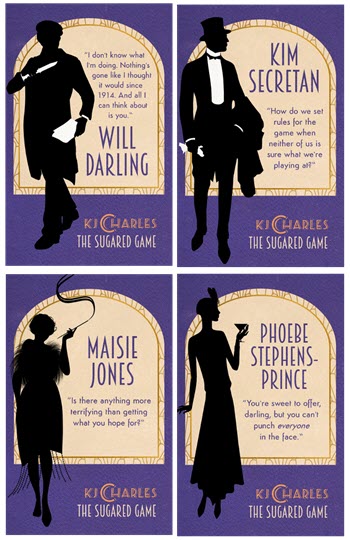
The Sugared Game takes up a few months after the events of Slippery Creatures. Although a standalone story it is decidedly a sequel and needs the previous book to set the context. With the four key characters—Will Darling, Kim Secretan, Maisie Jones, and Phoebe Stephens-Prince—firmly established Charles is able to expand the action both in terms of romance and adventure.

KJ Charles characters Will Darling Kim Secretan Maisie Jones Phoebe Stephens-PrinceThe story opens with Will taking best friend Maisie to the High-Low Club for an evening on the town. The club is glamorous but seedy, clearly a haven for nefarious doings of all sorts. It becomes the focus of the plot and the continuously fractured romance between Will and Kim. While at the club Will meets a one-time military compatriot. Kim, who initially is as unreliable, and irresistible, makes use of Will’s connection, turning the bookseller’s finally neatened world into one more secretive, criminal, and underhanded. 

If Slippery Creatures was something of a romp, The Sugared Game is tougher, occasionally meaner, taking a deeper look at the gents as the taut plots winds into something more twisty and and dangerous for them both. Trust, the lack thereof that is, continues to center the emotional dynamics here.

Kim’s fiancée Phoebe and Will’s best friend Maisie have their own tale as Maisie, with Phoebe’s solid support, tries to establish herself with the fashion design set. Unlike the men, the women have a strong and growing friendship. Staying close to the historical reality of the times, the women struggle more to be taken seriously. Phoebe, a glamorous and wealthy aristocrat is viewed as ornamental; Phoebe’s lower class standing and race are held against her. Only Phobe’s patronage gives her the edge up, capable as Maisie is. Still, the women willingly use societal assumptions as an effective disguise that allows them to skirt those very expectations.

While I personally did not feel as engaged with the story—and that’s on me; the 1920s noir/pulp style just isn’t my thing—I very much liked how Charles’ lets Will and Kim mature, something she gently and effectively explores in a side story she sent her readers via her newsletter (“To Trust Man on His Oath” —see link at the end of this essay.) Will tends to think he has his act together; it’s Kim who has a problem. By the end of the tale, Will learns new things about himself and discovers, too, that Kim can in fact be be trusted


Subtle Blood

Book 3, the last of the trilogy, is a wonderfully blazing and hugely satisfying conclusion to the series. NPR’s Maya Rodale pronounced Subtle Blood a “sexy, elegant and romantic murder mystery” and it is every bit that. We leap right back into things with the murder of a man at a gentleman’s club, the suspected killer being the older brother of the charming and devious Lord Arthur “Kim” Secretan.

Kim and his friend and lover, Will Darling, the rough and tumble, capably murderous WWI soldier turned bookseller, set out to exonerate Kim’s brother despite the likelihood that he very much did the deed. At risk are Kim and Will’s practical and romantic futures. There is derring-do, political and social intrigue (historically accurate while providing fierce commentary on our modern time), and lots of energetic as well as tender, on-page sex. The plot is believable and strong though I found myself occasionally feeling a bit rushed.


A challenge in writing a series is how to maintain character consistency while permitting the character to change through the course of the action. Charles struggled with this (she talks about it here). There would be a Twitter comment here and there that suggested Kim’s development was not easy to work out or write out. At first I wasn’t sure if she’d pulled it off.


Will comes across as a well-grounded bloke and Kim a flip moneyed man-about-town in Book 1 (Slippery Creatures). In Book 2 (The Sugared Game) Kim needs to flit about to resolve the problem and Will anchors the doings, but neither seem to be entirely facing each other, or rather, seem unprepared to deal with doings outside of the plot, as it were. They haven’t dealt with each other.

“Yet I must thank you for admitting that you are thieves rather pretending that your work is in a respectable profession . . . Rascal thieves, Here’s gold. Go, suck the subtle blood o’ the grape, Till the high fever seethe your blood to froth, And so ’scape hanging. . . .”
~ Shakespeare. Timon of Athens, Act 4, Sc. 3

In Subtle Blood the ravens come home to roost. Kim must deal with his rather appalling family and his own need for at least one family member’s approval. Will finds that the pragmatic, just-endure-today approach that let him kill during the war killing without remorse, with pride even, does not work when it comes to love. Kim matures and finds his metier. Will follows but more slowly. And for once, it is Kim who leads here in self understanding and kindness for all that he still struggles with the pain of what he has to do and who he is.

Kim’s one-time fiancée, Phoebe Stephens-Prince, now Lady Waring, and Darling’s long-time good friend, Maisie Jones, who is a Paris designer now, play secondary but pivotal roles in this last tale. They are strong women and, while supportive of the gents, do not shrink from forcing Kim and Will (and, surprisingly, Kim’s father) to deal with the consequences of their actions and, in Will’s case, to grapple with the emotional realities of loving a man beyond one day at a time.

The series ends with Charles’ promised happily ever after (HEA) and, in theory, that’s that. But where Will and Kim end up suggests sequels might be possible. Personally, I’d go for a series with Phoebe & Maisie as the leads. How Charles handles Kim and Phoebe’s broken engagement and Maisie’s reinvented self and identity seemed to me a tad predictable but it does set them up for their own books.


For all that the Will Darling books are romance, they are not sweetness and light. People have pasts and they hurt as a result. There are difficult situations, death, and considerable mayhem. Charles considerately posts content warnings on her website here.

Finally, Charles did a rather lovely thing for her readers—wrote supplemental tales to this trilogy. Those signed up for her newsletter received them first, but since then she has posted the side stories on her website.


NOTE: This essay is an updated version reviews I originally published on my artist blog, Dante’s Wardrobe.

© J.A. Jablonski 2021. All rights reserved.

ABOUT BOOK THOUGHTS

“Book Thoughts” is an intermittent column within my blog. The essays are not so much book reviews as book responses. I like to converse with and around the books I read.

HOW TO CITE THIS POST

Jablonski, J.A. (2021, Aug 16). KJ Charles |The Will Darling Adventures | Pt. 2.  Blog post. J.A. Jablonski (website). https://jajablonski.com/2021/08/16/kj-charles-will-darling-pt2/

IMAGE CREDITS

Covers of The Will Darling Adventures. From KJ Charles Website.

Silhouette portraits of Will Darling, Kim Secretan, Maisie Jones, and Phoebe Stephens-Prince. From a Twitter book announcement by KJ Charles.


SOURCES


Disclaimer: As KJ Charles sells/promotes her books via her own website, I do not link to the Bookshop.org listings. See the first link below.

[1] Charles, KJ. (2020, 2021). The Will Darling Adventures. (Slippery Creatures, The Sugared Game, & Subtle Blood). KJC Books.

[2] Charles, KJ. (2021, May 24). How to Write a Book When You Can’t write a Book. Blog Post. KJ Charles website.


KJ Charles | The Will Darling Adventures | Pt. 1

Covers of KJ Charles books showing Darling & Kim Secretan facing each other
The Will Darling Adventures by K.J. Charles
Cover Art by Tiferet Design


“The success of Charles’ storytelling is that she draws the reader into the narrative romp and the luxuriating passions while also promising the connection of souls that we also desire.“

It’s been some time since I have found books so entertaining as The Will Darling Adventures trilogy by KJ Charles. [1] Though new to me, she’s been writing for a while now. This title is the first I’ve read of hers and I am looking forward to reading more.

Series description from Charles’ website:

A m/m romance trilogy in the spirit of Golden Age pulp fiction. It’s the 1920s and tensions are rising along with hemlines. Soldier-turned-bookseller Will Darling finds himself tangled up in spies and secret formulas, clubs and conspiracies, Bolsheviks, blackmail, and Bright Young Things. And dubious aristocrat Lord Arthur ‘Kim’ Secretan is right in the middle of it all: enigmatic, unreliable, and utterly irresistible.

I’d only discovered Charles, who has been writing for no small while, this past year after seeing a sharply written, witty retweet of hers on Twitter. And although I do not typically read in the romance genre, Reader, I followed her immediately and started in with Book 1 of the series.

Slippery Creatures opens things in a mostly certainly lively fashion. The 1963 movie Tom Jones (with Albert Finney in the titular role) came to mind immediately. [2] Specifically, the famous eating scene. Here is Wook Kim’s 2012 summary of it:

KJ Charles magpie logo“Bawdy, boisterous, and full of heart, ‘Tom Jones’ won four Oscars, including Best Picture and Best Director (for Terry Richardson). In the film’s perhaps most famous scene, the raffish but utterly charming Tom (Albert Finney) shares a tavern meal with a Mrs. Waters (who, unbeknownst to Tom, just may be his mother). The dinner begins innocently enough, but their furtive glances soon turn into almost incandescent gazing: even a village fool can see where this is going. It’s a simple two-shot scene, oft parodied, that fleshes out, both literally and figuratively, the sometimes eye-winkingly genteel descriptions in Henry Fielding’s picaresque novel.” [3]

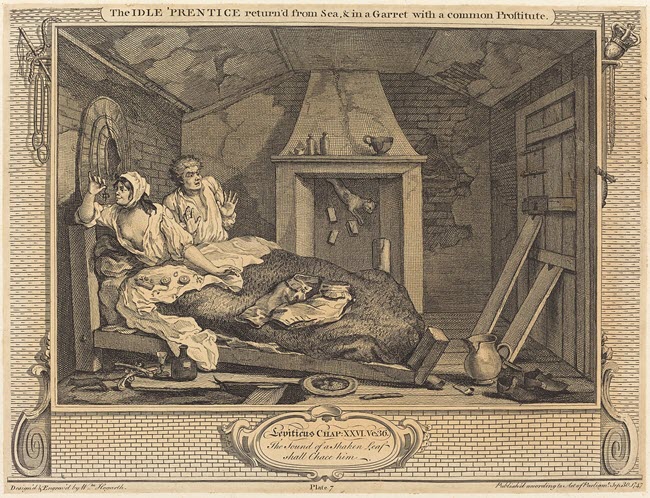
The young Finney, I imagine, would be a lovely Will Darling, the rough and tumble, murderous WWI soldier turned bookseller in Creatures. Opposite him, as the charming and devious Lord Arthur “Kim” Secretan, I’d cast Matthew Goode. In fact, for all that Creatures is set in England in the 1920s after the so-called Great War, I kept harkening back to my grad school days when I seriously considered shifting from my focus on medieval lit to 18th-century stuff. Tom Jones, yes, and the roaring, bawdy William Hogarth, “English painter, printmaker, pictorial satirist, social critic, and editorial cartoonist.” (Wikipedia) Not surprisingly, Tom Jones author Henry Fielding was a friend.

Hogarth engraving of young man in bed with partially clothed woman

Hogarth’s engraving of

The Idle ‘Prentice return’d from Sea & in a Garret with a common Prostitute, 1747

Creatures has that kind of joie de vivre, raucous, broadly adventurous, and terrifically sexy. Here’s the quick intro  from Charles’ website:

Will Darling came back from the Great War with a few scars, a lot of medals, and no idea what to do next. Inheriting his uncle’s chaotic second-hand bookshop is a blessing…until strange visitors start making threats. First a criminal gang, then the War Office, both telling Will to give them the information they want, or else. Will has no idea what that information is, and nobody to turn to, until Kim Secretan—charming, cultured, oddly attractive—steps in to offer help. As Kim and Will try to find answers and outrun trouble, mutual desire grows along with the danger. And then Will discovers the truth about Kim. His identity, his past, his real intentions. Enraged and betrayed, Will never wants to see him again. But Will possesses knowledge that could cost thousands of lives. Enemies are closing in on him from all sides—and Kim is the only man who can help. A 1920s m/m romance trilogy in the spirit of Golden Age pulp fiction.

It took me a bit to get into Creatures as I am, admittedly, a reader with serious attitude. I almost put it down as a no-go, in part because the character of the bookseller is such a worn trope. I follow Charles on Twitter, though. She is sharp, witty, opinionated, and writes a damn good tweet. So I skipped ahead a chapter or two and, oh wonderful! Creatures indeed resurrects the Golden Age of pulp fiction in that it is action-packed, clever and funny, and moves the reader along right proper. What’s unique and particularly intriguing and frankly, appreciated, is its eroticism, queer specifically.

Charles notes on her Content Warnings web page that all of her “full-length novels contain on-page sex and swearing.” On-page, oh my, yes. (Though the swearing in Creatures escaped me, I have to admit. Then again, the F-word is so frequent in my own natterings that I hardly see it.) The sex is explicit, occasionally quite raw, and matter of fact. It is also historically accurate in that Charles keeps the mindset of her characters in their time period. On that Warnings page she states that her “books are historicals and thus set against a background of Georgian/Victorian/20s British attitudes to sex and gender. I’ve mentioned homophobia where it’s explicit.” 

Will Darling and Kim Secretan cannot be out though Secretan’s proclivities are known to certain colleagues. Secretan has a fiancée–the delightfully solid Phoebe Stephens-Prince–and Darling a good friend, the pragmatic and smart Maisie Jones. So their couplings are intense but always guarded. It adds to the sexual tension that they are so but also brings painfully to mind how even now the LGBTQ community lives, or is forced to live, in society’s substrates.

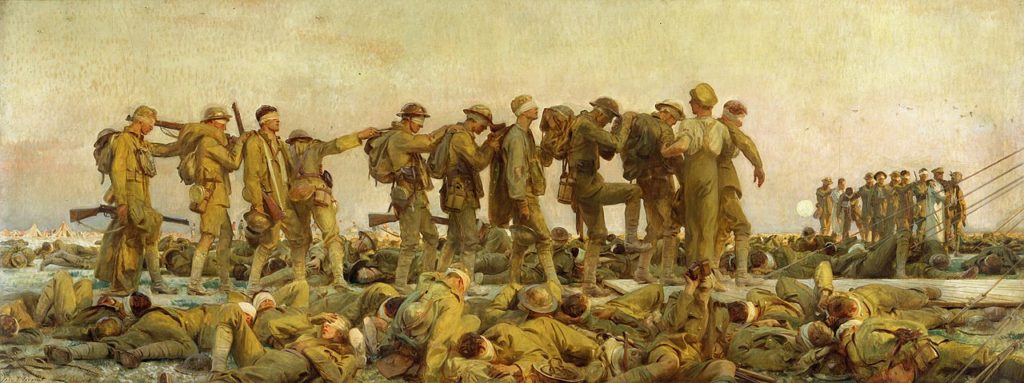
For all that Creatures is a kind of romp, with the underlying humor of the noir and pulp fiction genres, the storytelling rests profoundly on Charles’ solid historical accuracy. There is a sobering tone: the social and emotional impact of World War I on a generation.
Wounded & gassed World War 1 soldiers march in a line, each with a hand on the man before him

“Gassed”
Imperial War Museum, London, John Singer Sargent, c. March 1919

At one point Darling has been captured and, it seems, likely left to die. As he struggles in darkness and cold, his time in the filthy trenches fills his mind. At another point, describing to Secretan what it was like to kill, the deep flavor of his actions vibrates from the page.
 

Like the current pandemic, Death doesn’t simply hover. It is quite real. Former soldier Darling isn’t simply a victim of war. Killing remains a visceral component of his psychology and behavior. Secretan, whose younger brother served as his war surrogate and died in his place, and who is himself something of what was referred to in 1920s London as a Bright Young Thing, is made melancholy and driven by the loss. Yes, there is sex for these two, but the sex is as much driven by a mortality-wrought aphrodisia as it is their own desires.

Charles describes The Will Darling Adventures series as a romance trilogy. She promises a happy ending, as she does for all her works. Will and Kim are of that mode, but they are also of an older tradition, that of romantic friends. I rather like the Wikipedia description of this:

“A romantic friendship, passionate friendship, or affectionate friendship is a very close but typically non-sexual relationship between friends, often involving a degree of physical closeness beyond that which is common in the contemporary Western societies. It may include for example holding hands, cuddling, hugging, kissing, giving massages, and sharing a bed, without sexual intercourse or other physical sexual expression.”

In Slippery Creatures the emotional tenor of a romantic friendship is just aborning as is the sexual romance. The success of Charles’ storytelling is that she draws the reader into the narrative romp and the luxuriating passions while also promising the connection of souls that we also desire. Quite a feat for a novel with such a breezing style and relative brevity.

See Part 2 of this review here.


NOTE: This essay is an updated version reviews I originally published on my artist blog, Dante’s Wardrobe.

© J.A. Jablonski 2021. All rights reserved.

 ABOUT BOOK THOUGHTS

“Book Thoughts” is an intermittent column within my blog. The essays are not so much book reviews as book responses. I like to converse with and around the books I read.


HOW TO CITE THIS POST

Jablonski, J.A. (2021, Aug 16). KJ Charles |The Will Darling Adventures | Pt. 1. Blog post. J.A. Jablonski (website). https://jajablonski.com/2021/08/16/kj-charles-will-darling-pt1/


IMAGE CREDITS

Covers of The Will Darling Adventures. From KJ Charles Website.

KJ Charles logo. From KJ Charles Website.

William Hogarth, The Idle ‘Prentice return’d from Sea & in a Garret with a common Prostitute, 1747. Public domain via Wikipedia.

“Gassed”  Imperial War Museum, London, John Singer Sargent, c. March 1919. Via Wikipedia.


SOURCES


Disclaimer: As KJ Charles sells/promotes her books via her own website, I do not link to the Bookshop.org listings. See the first link below.

[1] Charles, KJ. (2020, 2021). The Will Darling Adventures. (Slippery Creatures, The Sugared Game, & Subtle Blood). KJC Books.

[2] Tom Jones film info via Wikipedia. Info on the original book (also from Wikipedia), The History of Tom Jones, a Foundling, by Henry Fielding. 

[3]  Kim, Wook. (2012, Jan 5). Top 10 Memorable Movie Eating Scenes. Populist column from Time.com.