Marco Carocari | Blackout

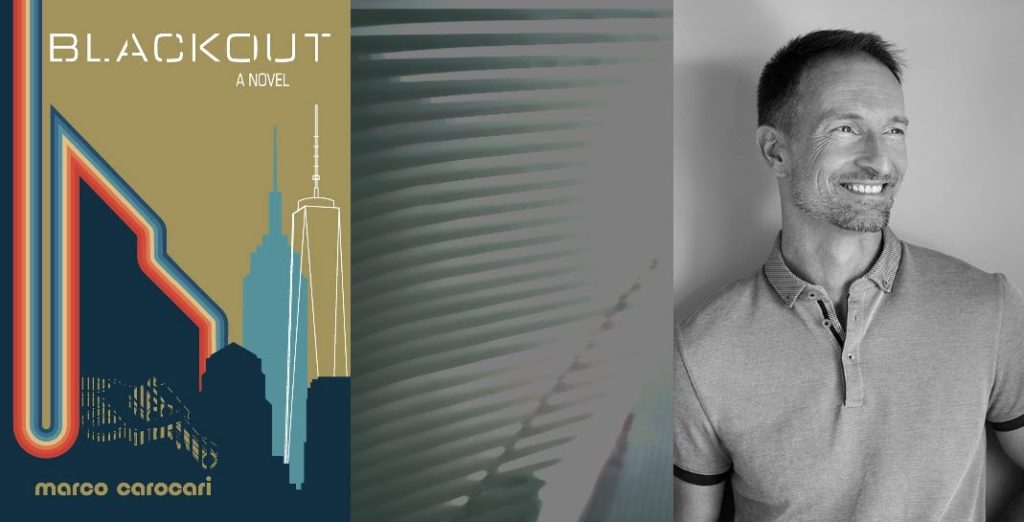
Cover of Blackout, blurred image of new World Trade Center, portrait of author Marco Carocari

“Having taken an end of year writing break I picked up ‘Blackout,’ read the first scene, and literally had to set the book down again. The setting so vivid; the energy an exquisite blend of melancholy and intensity; and a man so real and so briefly on the stage before me.”

It always strikes me when a book I hadn’t thought would strike me does. Especially when it is something I might not typically read. I love me a well-done mystery (not cozy though, thank you) but crime thrillers just don’t do it for me. Nor do roller coasters, horror movies, or watching a car accident happen before my eyes (which has happened three times, once somewhat gruesomely). I guess you could say I don’t do adrenaline very well.

And in some ways I don’t do reading very well. It’s extremely difficult for me to lose myself in a book. My entire professional life involved reading and analyzing text. Twice—once after finishing my master’s written comps exam in English then again after completing my doctoral comps—I was unable to read for pleasure for nearly eight months. Add to that years of book and database indexing where the sole purpose was to dissect content into its informational parts and labels; and years of teaching writing where my job was to help students work out how to express their ideas in clear, correct, focused prose.

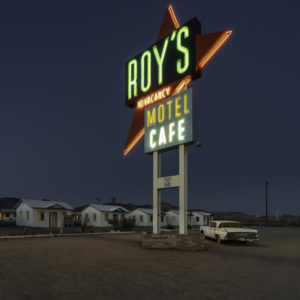
White male nude in profile from waist up with tatoos on back Outdoor shot of old neon hotel sign. Roy's Motel. At base of sign are 3 small house-shapes and an old car. Black and white view out of the door of an old RV trailer. View is a desert with a beat-up metal chair in foreground, wooden fence midground, and sagebrush hills with sky and clouds above in background

Photography by Marco Carocari

So why did I immediately preorder Marco Carocari’s Blackout? [1]

The cover art, for one. Having been an assistant manager in a bookstore I tend to be immune to (or perhaps bored by is the better phrase) the often generic, repetitive designs. But the art by Mark Gutkowski, with its Art Deco echo, the NYC then-and-now silhouettes, and the colors—khaki, midnight blue, and rainbow flashing—caught my own artist’s eye and sensibility. Second, author Carocari is also a photographer whose work manifests technical rigor, intense focus, and artistic intimacy. [2] My own approach as a writer is to relentlessly visualize. If I can’t see a scene, can’t see the people moving about, I simply cannot write it.

THE STORY

Here is the overview of Blackout from Carocari’s website:

“Strait-laced forty-something Franco picked the wrong night to get freaky. A hook-up with a hot guy on his Manhattan rooftop, and a joint he’s unaware is laced, leaves him dazed. And —if memory serves him— the sole witness to a murder across the street.


Except, the cops can’t find a crime scene or a body, and Franco’s perforated recollections and conflicting testimony leave the detectives unimpressed. When days later the mutilated body of a philanthropic millionaire is discovered, he’s not only shocked to learn he knew him, but with Franco’s fingerprints all over the crime scene, he quickly graduates from unreliable witness to prime suspect.


Unsettled, and confronted with forty year old memories, when Franco’s father was murdered in front of him during Manhattan’s infamous blackout, a shocking revelation finally unmasks the man who pulled the trigger that night. And painting Franco the perfect suspect. With a target on his back and time running out, the truth will set Franco free, or earn him a toe tag at the morgue…”

Power, Precision, and Place

I don’t know why it took me this long to read Blackout—the book came out in March 2021. I am myself writing just now (a character-driven academic mystery as well as an involved speculative SF thing simmering alongside) and am one of those writers who dare not read certain other things when writing. I had a feeling Carocari’s book was one of them.

This is a compliment (I think) that I flinch at the potential power or influence of another’s work. Fiona Erskine’s Phosphate Rocks is sitting within my line of sight as I type this, also unread beyond the first few pages—those read thrice but no more than that, though her time is soon. [3] It’s a kind of respect in my universe to not want to read certain books until the moment is right.

Reader, this was such a moment. Having taken an end of year writing break I picked up Blackout, read the first scene, and literally had to set the book down again. The setting so vivid; the energy an exquisite blend of melancholy and intensity; and a man so real and so briefly on the stage before me. I was immediately caught by what I tweet-commented as the “quick, dark, graceful writing.”

And precise . . . which didn’t surprise me given the quality of Carocari’s photographic eye.

I’ve only been to New York City once and as a well-grown adult and even then for only two days. With the exception of similarly brief visits to London in the early 80s and San Francisco in the 90s, I’d never felt so immediately at home as I did in NYC. Reading Blackout gave me that same sense of familiarity and, in a way, of coming home. He didn’t have to world build for me. I was there! Sights, smells (the smells!), the pitch dark of the 1977 blackout, even the concrete beneath my feet.

HANGING TEN
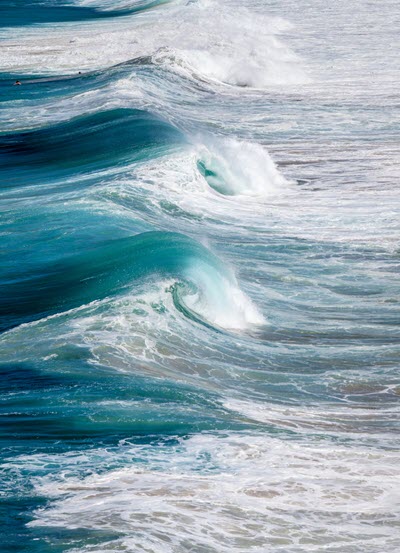
Ocean wavesWhen I was a kid someone told me that waves always come in sevens with the last, seventh wave being the largest. I can remember sitting on the sandy edge of a small lake when summer-swimming with family, sitting and counting the waves as they came in. Maybe the theory doesn’t work in small lakes. I can only recall watching and watching as the rippled lines all looked the same as they hit the shore.

That image came to mind when reading Blackout, though here the waves did increase. I had this wonderful sense of being aboard a small boat or surfboard atop as each wave of the narrative pushed forward, rushing towards the shore with increasing intensity. Writer-Me noted “Oh, this is what they mean by a thriller.” Reader-Me just hung on surfer-like, for the ride.

Music is powerful element in Blackout and adds to the crescendo effect. Main character Franco DiMaso works at a club as one of his three jobs. There’s a lot of dancing and a lot of throbbing beats that surround the Franco and his friends. Although set in 2016, the musical vibe carried me back to when I was nineteen and first really fell in love; when I met my boyfriend’s gay friends who were the first out gay men I’d ever met; when I came into being in a way. The music of the Blackout’s characters and the deep sensibility that their music was the book’s own soundtrack gave me that sweet time back again. (Carocari includes a playlist at the end of the book and I have to say I wanted to hug him for that!)

The personable and the real
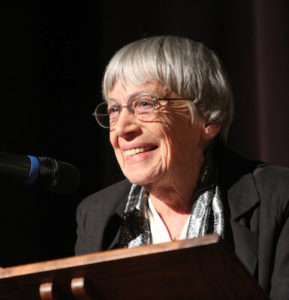
Ursula K. Le Guin. An older Caucasion woman with short white hair, face with creases, wearing glasses, stands at a podium. She is smiling genially.Invariably I read books on multiple levels, some of which have little to do with what the book is literally about in terms of plot or genre. That happened reading Carocari where I jumped both.

Blackout is as far away from speculative science fiction as you can get. Composing my thoughts for this post I was rather surprised, then, that two books insisted on resonating alongside: Ursula K. Le Guin’s The Dispossessed and The Left Hand of Darkness. [4, 5] Here are short descriptions for each:

The Dispossessed (1974): “This novel is about the radically different societies on two close planets. On Urras, there are multiple states, each with their own government. On Anarres, there is no government or economic system. Shevek, a physicist on Anarres, wants to break the rules of his world and travel to Urras, not only to speak with other physicists who understand and are excited by his theories, but to promote friendship between the two planets. . . . ‘ The Dispossessed’ is a novel of anarchy and individualism, of utopias and paradise.” (From Bookrags; link below)


The Left Hand of Darkness (1969): “The novel follows the story of Genly Ai, a human native of Terra, who is sent to the planet of Gethen as an envoy of the Ekumen, a loose confederation of planets. Ai’s mission is to persuade the nations of Gethen to join the Ekumen, but he is stymied by a lack of understanding of their culture. Individuals on Gethen are ambisexual, with no fixed sex; this has a strong influence on the culture of the planet, and creates a barrier of understanding for Ai.” (From Wikipedia; link below)

I say just now I was rather surprised, more like baffled. My goal of getting this essay posted earlier this week was put on pause while I let the matter marinate. Finally what surfaced had little to do with the plots or genres of the three books and everything to do with two critical notions: the especial connections people make with each other and the authenticity of persons.

I mentioned that crime thrillers aren’t my jam. Blackout almost went on my did-not-finish­ book stack at the moment Franco has to identify a body in a morgue. My reaction was pretty much the same as his and I wasn’t sure I could go on, much as I wanted to find out what happened. What kept me going was what kept Franco going: the anchor he finds in the tight, eclectic circle of his friends. Shevek and Ai, the central characters in Le Guin’s two books are similarly grounded and literally saved, emotionally and physically, by core friendships.

In all three books the friendships have been nurtured over time, challenged by events, and in the end, solidified into what is colloquially referred to these days as found family. I kept expecting Franco’s friends to offload him for his stubborn and occasionally flakey behavior but they never do. Shevek, who comes close to suicide through a combination of intellectual pride and loneliness, is saved by a long ago friend who has conquered his own pride and who offers the salve of love and friendship. Ai’s inability to see beyond his default male template of sex and gender nearly derails his mission as Envoy, a mission saved by the sacrifice of a person Ai later realizes was his only and dearest friend.

Franco, Shevek, and Ai, all male in this instance, are in the end fundamentally and authentically themselves, respectively gay, cis-but-sexually-open, and cis. This I think is the doorway connecting the three books in my mind; not the gender/sexuality specifically, but the solidity of the respective identities and how Carocari and Le Guin write them as normative.

My voice has always been my own so to read a story with a very strong voice is deeply satisfying to me, no matter what the voice. Though the thriller aspect of this book will not stay with me I think, in terms of representation this is a book that I will cherish. I am not any of the people in it and though not gay specifically, I am other. Aside from the story, aside from the writing, I felt seen in a way I rarely experience in daily life. These people, Franco and his friends, were my people. There aren’t too many books that give me that.

Postscript: I deliberately did not read any reviews of Blackout or interviews with Carocari prior to reading his book. Finding out now that he is not native-born or raised American and managed to capture NYC as he did is some kind of wonderful. A tip of the cap to you, sir.

If you have a question or comment for me, drop me a line via my Contact page.

© J.A. Jablonski 2022. All rights reserved.

ABOUT BOOK THOUGHTS

“Book Thoughts” is an intermittent column within my blog. The essays are not so much book reviews as book responses. I like to converse with and around the books I read.

How to cite this post

Jablonski, J.A. (2022, Jan 6). Marco Carocari | Blackout. Blog post. J.A. Jablonski (website). https://jajablonski.com/2022/01/06/carocari_blackout


IMAGE CREDITS

Header image

    • Cover of Marco Carocari’s book, Blackout. From Amazon.
    • World Trade Center, NY. Photo by Lukas Blaskevicius on Unsplash. Modified & retinted.
    • Marco Carocari. Author photograph. From Mr. Carocari’s photography website About page.

Ocean waves. Photo by Photoholgic on Unsplash

Photography by Marco Carocari: Man in profile with tatoos; Roy’s Motel; View of desert from RV trailer door. All used by permission.

Photo of author Ursula K. Le Guin © 2014 by Jack Liu. See Le Guin’s Publicity Photos page.

SOURCES

Disclaimer: As a Bookshop Affiliate (US only) I will earn a commission if you click through on a book title I’ve linked to and make a purchase.

[1] Carocari, Marco. (2021). Blackout. Level Best Books. His author website is here.

[2] Carocari, Marco. Mr. Carocari’s photography website.

[3] Erskine, Fiona. (2021). Phosphate Rocks: A Death in Ten Objects. Sandstone Press. ISBN: 9781913207526

[4] Le Guin, Ursula K. (1974). The Dispossessed. Avon Books. (Bookshop link is to the Harper Voyager 1994 edition.) The Bookrags quotation above can be found here.

[5] Le Guin, Ursula K. (1969). The Left Hand of Darkness. Ace Books. (Bookshop link is to the Ace Books 1987 edition.) The Wikipedia quotation above can be found here.
KJ Charles | The Will Darling Adventures | Pt. 2

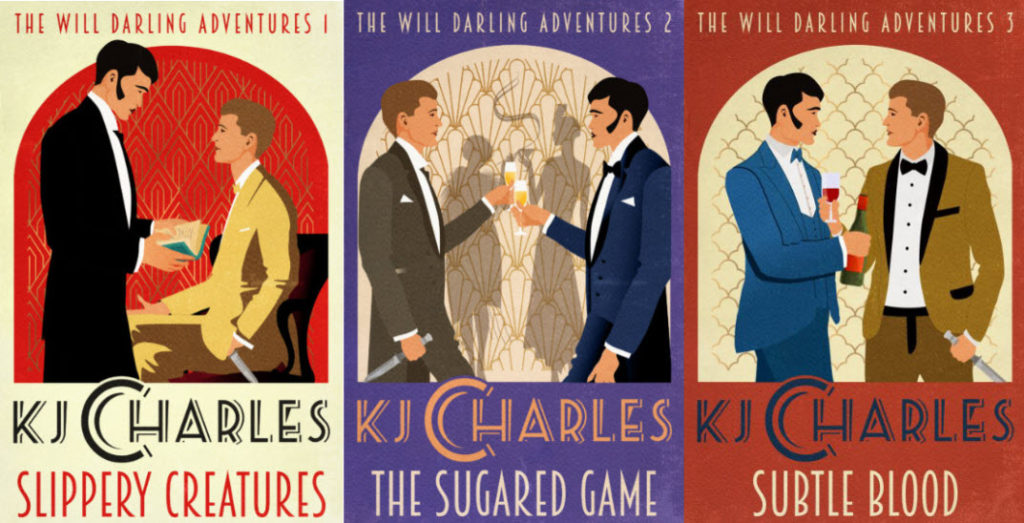
Covers of KJ Charles books showing Darling & Kim Secretan facing each other
The Will Darling Adventures by K.J. Charles [1]
Cover Art by Tiferet Design


For all that the Will Darling books are romance, they are not sweetness and light. People have pasts and they hurt as a result.

KJ Charles reports that writing the final book of The Will Darling Adventures trilogy (Subtle Blood) was especially difficult, describing the experience “like driving [a Land Rover] into a tar pit.” [2] As with many authors writing at that same time, the Covid pandemic laid her low. I, for one, am grateful she persevered. Reading Books 2 and 3 both comforted and kept me reasonably sane in the face of the virus’ impact in my own life.

Series description from Charles’ website:

A m/m romance trilogy in the spirit of Golden Age pulp fiction. It’s the 1920s and tensions are rising along with hemlines. Soldier-turned-bookseller Will Darling finds himself tangled up in spies and secret formulas, clubs and conspiracies, Bolsheviks, blackmail, and Bright Young Things. And dubious aristocrat Lord Arthur ‘Kim’ Secretan is right in the middle of it all: enigmatic, unreliable, and utterly irresistible.

The Sugared Game

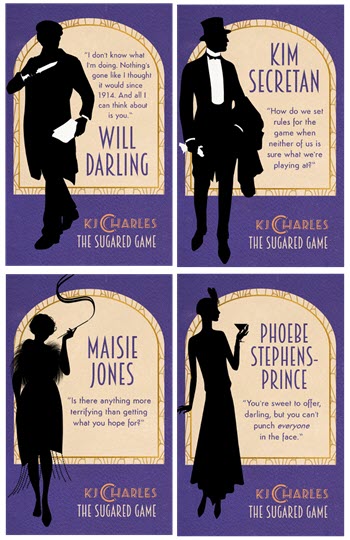
The Sugared Game takes up a few months after the events of Slippery Creatures. Although a standalone story it is decidedly a sequel and needs the previous book to set the context. With the four key characters—Will Darling, Kim Secretan, Maisie Jones, and Phoebe Stephens-Prince—firmly established Charles is able to expand the action both in terms of romance and adventure.

KJ Charles characters Will Darling Kim Secretan Maisie Jones Phoebe Stephens-PrinceThe story opens with Will taking best friend Maisie to the High-Low Club for an evening on the town. The club is glamorous but seedy, clearly a haven for nefarious doings of all sorts. It becomes the focus of the plot and the continuously fractured romance between Will and Kim. While at the club Will meets a one-time military compatriot. Kim, who initially is as unreliable, and irresistible, makes use of Will’s connection, turning the bookseller’s finally neatened world into one more secretive, criminal, and underhanded. 

If Slippery Creatures was something of a romp, The Sugared Game is tougher, occasionally meaner, taking a deeper look at the gents as the taut plots winds into something more twisty and and dangerous for them both. Trust, the lack thereof that is, continues to center the emotional dynamics here.

Kim’s fiancée Phoebe and Will’s best friend Maisie have their own tale as Maisie, with Phoebe’s solid support, tries to establish herself with the fashion design set. Unlike the men, the women have a strong and growing friendship. Staying close to the historical reality of the times, the women struggle more to be taken seriously. Phoebe, a glamorous and wealthy aristocrat is viewed as ornamental; Phoebe’s lower class standing and race are held against her. Only Phobe’s patronage gives her the edge up, capable as Maisie is. Still, the women willingly use societal assumptions as an effective disguise that allows them to skirt those very expectations.

While I personally did not feel as engaged with the story—and that’s on me; the 1920s noir/pulp style just isn’t my thing—I very much liked how Charles’ lets Will and Kim mature, something she gently and effectively explores in a side story she sent her readers via her newsletter (“To Trust Man on His Oath” —see link at the end of this essay.) Will tends to think he has his act together; it’s Kim who has a problem. By the end of the tale, Will learns new things about himself and discovers, too, that Kim can in fact be be trusted


Subtle Blood

Book 3, the last of the trilogy, is a wonderfully blazing and hugely satisfying conclusion to the series. NPR’s Maya Rodale pronounced Subtle Blood a “sexy, elegant and romantic murder mystery” and it is every bit that. We leap right back into things with the murder of a man at a gentleman’s club, the suspected killer being the older brother of the charming and devious Lord Arthur “Kim” Secretan.

Kim and his friend and lover, Will Darling, the rough and tumble, capably murderous WWI soldier turned bookseller, set out to exonerate Kim’s brother despite the likelihood that he very much did the deed. At risk are Kim and Will’s practical and romantic futures. There is derring-do, political and social intrigue (historically accurate while providing fierce commentary on our modern time), and lots of energetic as well as tender, on-page sex. The plot is believable and strong though I found myself occasionally feeling a bit rushed.


A challenge in writing a series is how to maintain character consistency while permitting the character to change through the course of the action. Charles struggled with this (she talks about it here). There would be a Twitter comment here and there that suggested Kim’s development was not easy to work out or write out. At first I wasn’t sure if she’d pulled it off.


Will comes across as a well-grounded bloke and Kim a flip moneyed man-about-town in Book 1 (Slippery Creatures). In Book 2 (The Sugared Game) Kim needs to flit about to resolve the problem and Will anchors the doings, but neither seem to be entirely facing each other, or rather, seem unprepared to deal with doings outside of the plot, as it were. They haven’t dealt with each other.

“Yet I must thank you for admitting that you are thieves rather pretending that your work is in a respectable profession . . . Rascal thieves, Here’s gold. Go, suck the subtle blood o’ the grape, Till the high fever seethe your blood to froth, And so ’scape hanging. . . .”
~ Shakespeare. Timon of Athens, Act 4, Sc. 3

In Subtle Blood the ravens come home to roost. Kim must deal with his rather appalling family and his own need for at least one family member’s approval. Will finds that the pragmatic, just-endure-today approach that let him kill during the war killing without remorse, with pride even, does not work when it comes to love. Kim matures and finds his metier. Will follows but more slowly. And for once, it is Kim who leads here in self understanding and kindness for all that he still struggles with the pain of what he has to do and who he is.

Kim’s one-time fiancée, Phoebe Stephens-Prince, now Lady Waring, and Darling’s long-time good friend, Maisie Jones, who is a Paris designer now, play secondary but pivotal roles in this last tale. They are strong women and, while supportive of the gents, do not shrink from forcing Kim and Will (and, surprisingly, Kim’s father) to deal with the consequences of their actions and, in Will’s case, to grapple with the emotional realities of loving a man beyond one day at a time.

The series ends with Charles’ promised happily ever after (HEA) and, in theory, that’s that. But where Will and Kim end up suggests sequels might be possible. Personally, I’d go for a series with Phoebe & Maisie as the leads. How Charles handles Kim and Phoebe’s broken engagement and Maisie’s reinvented self and identity seemed to me a tad predictable but it does set them up for their own books.


For all that the Will Darling books are romance, they are not sweetness and light. People have pasts and they hurt as a result. There are difficult situations, death, and considerable mayhem. Charles considerately posts content warnings on her website here.

Finally, Charles did a rather lovely thing for her readers—wrote supplemental tales to this trilogy. Those signed up for her newsletter received them first, but since then she has posted the side stories on her website.


NOTE: This essay is an updated version reviews I originally published on my artist blog, Dante’s Wardrobe.

© J.A. Jablonski 2021. All rights reserved.

ABOUT BOOK THOUGHTS

“Book Thoughts” is an intermittent column within my blog. The essays are not so much book reviews as book responses. I like to converse with and around the books I read.

HOW TO CITE THIS POST

Jablonski, J.A. (2021, Aug 16). KJ Charles |The Will Darling Adventures | Pt. 2.  Blog post. J.A. Jablonski (website). https://jajablonski.com/2021/08/16/kj-charles-will-darling-pt2/

IMAGE CREDITS

Covers of The Will Darling Adventures. From KJ Charles Website.

Silhouette portraits of Will Darling, Kim Secretan, Maisie Jones, and Phoebe Stephens-Prince. From a Twitter book announcement by KJ Charles.


SOURCES


Disclaimer: As KJ Charles sells/promotes her books via her own website, I do not link to the Bookshop.org listings. See the first link below.

[1] Charles, KJ. (2020, 2021). The Will Darling Adventures. (Slippery Creatures, The Sugared Game, & Subtle Blood). KJC Books.

[2] Charles, KJ. (2021, May 24). How to Write a Book When You Can’t write a Book. Blog Post. KJ Charles website.


KJ Charles | The Will Darling Adventures | Pt. 1

Covers of KJ Charles books showing Darling & Kim Secretan facing each other
The Will Darling Adventures by K.J. Charles
Cover Art by Tiferet Design


The success of Charles’ storytelling is that she draws the reader into the narrative romp and the luxuriating passions while also promising the connection of souls that we also desire.

It’s been some time since I have found books so entertaining as The Will Darling Adventures trilogy by KJ Charles. [1] Though new to me, she’s been writing for a while now. This title is the first I’ve read of hers and I am looking forward to reading more.

Series description from Charles’ website:

A m/m romance trilogy in the spirit of Golden Age pulp fiction. It’s the 1920s and tensions are rising along with hemlines. Soldier-turned-bookseller Will Darling finds himself tangled up in spies and secret formulas, clubs and conspiracies, Bolsheviks, blackmail, and Bright Young Things. And dubious aristocrat Lord Arthur ‘Kim’ Secretan is right in the middle of it all: enigmatic, unreliable, and utterly irresistible.

I’d only discovered Charles, who has been writing for no small while, this past year after seeing a sharply written, witty retweet of hers on Twitter. And although I do not typically read in the romance genre, Reader, I followed her immediately and started in with Book 1 of the series.

Slippery Creatures opens things in a mostly certainly lively fashion. The 1963 movie Tom Jones (with Albert Finney in the titular role) came to mind immediately. [2] Specifically, the famous eating scene. Here is Wook Kim’s 2012 summary of it:

KJ Charles magpie logo“Bawdy, boisterous, and full of heart, ‘Tom Jones’ won four Oscars, including Best Picture and Best Director (for Terry Richardson). In the film’s perhaps most famous scene, the raffish but utterly charming Tom (Albert Finney) shares a tavern meal with a Mrs. Waters (who, unbeknownst to Tom, just may be his mother). The dinner begins innocently enough, but their furtive glances soon turn into almost incandescent gazing: even a village fool can see where this is going. It’s a simple two-shot scene, oft parodied, that fleshes out, both literally and figuratively, the sometimes eye-winkingly genteel descriptions in Henry Fielding’s picaresque novel.” [3]

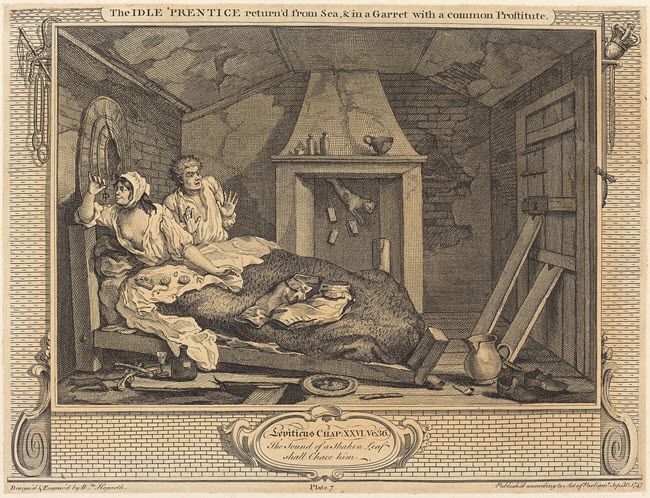
The young Finney, I imagine, would be a lovely Will Darling, the rough and tumble, murderous WWI soldier turned bookseller in Creatures. Opposite him, as the charming and devious Lord Arthur “Kim” Secretan, I’d cast Matthew Goode. In fact, for all that Creatures is set in England in the 1920s after the so-called Great War, I kept harkening back to my grad school days when I seriously considered shifting from my focus on medieval lit to 18th-century stuff. Tom Jones, yes, and the roaring, bawdy William Hogarth, “English painter, printmaker, pictorial satirist, social critic, and editorial cartoonist.” (Wikipedia) Not surprisingly, Tom Jones author Henry Fielding was a friend.

Hogarth engraving of young man in bed with partially clothed woman

Hogarth’s engraving of

The Idle ‘Prentice return’d from Sea & in a Garret with a common Prostitute, 1747

Creatures has that kind of joie de vivre, raucous, broadly adventurous, and terrifically sexy. Here’s the quick intro  from Charles’ website:

Will Darling came back from the Great War with a few scars, a lot of medals, and no idea what to do next. Inheriting his uncle’s chaotic second-hand bookshop is a blessing…until strange visitors start making threats. First a criminal gang, then the War Office, both telling Will to give them the information they want, or else. Will has no idea what that information is, and nobody to turn to, until Kim Secretan—charming, cultured, oddly attractive—steps in to offer help. As Kim and Will try to find answers and outrun trouble, mutual desire grows along with the danger. And then Will discovers the truth about Kim. His identity, his past, his real intentions. Enraged and betrayed, Will never wants to see him again. But Will possesses knowledge that could cost thousands of lives. Enemies are closing in on him from all sides—and Kim is the only man who can help. A 1920s m/m romance trilogy in the spirit of Golden Age pulp fiction.

It took me a bit to get into Creatures as I am, admittedly, a reader with serious attitude. I almost put it down as a no-go, in part because the character of the bookseller is such a worn trope. I follow Charles on Twitter, though. She is sharp, witty, opinionated, and writes a damn good tweet. So I skipped ahead a chapter or two and, oh wonderful! Creatures indeed resurrects the Golden Age of pulp fiction in that it is action-packed, clever and funny, and moves the reader along right proper. What’s unique and particularly intriguing and frankly, appreciated, is its eroticism, queer specifically.

Charles notes on her Content Warnings web page that all of her “full-length novels contain on-page sex and swearing.” On-page, oh my, yes. (Though the swearing in Creatures escaped me, I have to admit. Then again, the F-word is so frequent in my own natterings that I hardly see it.) The sex is explicit, occasionally quite raw, and matter of fact. It is also historically accurate in that Charles keeps the mindset of her characters in their time period. On that Warnings page she states that her “books are historicals and thus set against a background of Georgian/Victorian/20s British attitudes to sex and gender. I’ve mentioned homophobia where it’s explicit.” 

Will Darling and Kim Secretan cannot be out though Secretan’s proclivities are known to certain colleagues. Secretan has a fiancée–the delightfully solid Phoebe Stephens-Prince–and Darling a good friend, the pragmatic and smart Maisie Jones. So their couplings are intense but always guarded. It adds to the sexual tension that they are so but also brings painfully to mind how even now the LGBTQ community lives, or is forced to live, in society’s substrates.

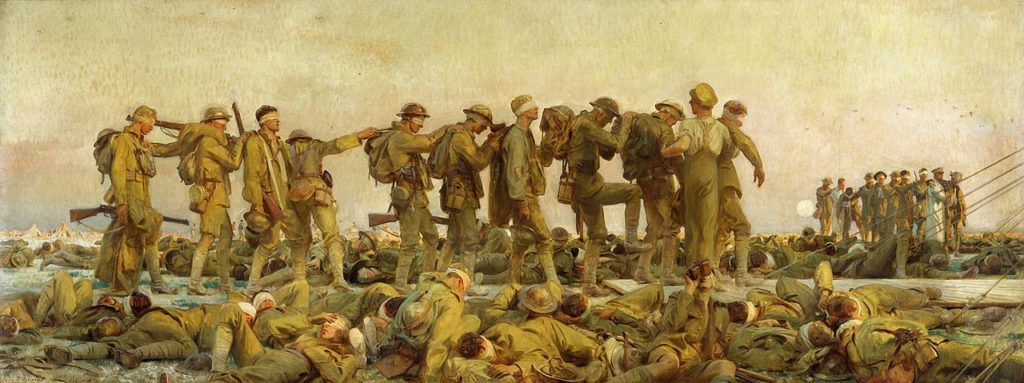
For all that Creatures is a kind of romp, with the underlying humor of the noir and pulp fiction genres, the storytelling rests profoundly on Charles’ solid historical accuracy. There is a sobering tone: the social and emotional impact of World War I on a generation.
Wounded & gassed World War 1 soldiers march in a line, each with a hand on the man before him

“Gassed”
Imperial War Museum, London, John Singer Sargent, c. March 1919

At one point Darling has been captured and, it seems, likely left to die. As he struggles in darkness and cold, his time in the filthy trenches fills his mind. At another point, describing to Secretan what it was like to kill, the deep flavor of his actions vibrates from the page.
 

Like the current pandemic, Death doesn’t simply hover. It is quite real. Former soldier Darling isn’t simply a victim of war. Killing remains a visceral component of his psychology and behavior. Secretan, whose younger brother served as his war surrogate and died in his place, and who is himself something of what was referred to in 1920s London as a Bright Young Thing, is made melancholy and driven by the loss. Yes, there is sex for these two, but the sex is as much driven by a mortality-wrought aphrodisia as it is their own desires.

Charles describes The Will Darling Adventures series as a romance trilogy. She promises a happy ending, as she does for all her works. Will and Kim are of that mode, but they are also of an older tradition, that of romantic friends. I rather like the Wikipedia description of this:

“A romantic friendship, passionate friendship, or affectionate friendship is a very close but typically non-sexual relationship between friends, often involving a degree of physical closeness beyond that which is common in the contemporary Western societies. It may include for example holding hands, cuddling, hugging, kissing, giving massages, and sharing a bed, without sexual intercourse or other physical sexual expression.”

In Slippery Creatures the emotional tenor of a romantic friendship is just aborning as is the sexual romance. The success of Charles’ storytelling is that she draws the reader into the narrative romp and the luxuriating passions while also promising the connection of souls that we also desire. Quite a feat for a novel with such a breezing style and relative brevity.

See Part 2 of this review here.


NOTE: This essay is an updated version reviews I originally published on my artist blog, Dante’s Wardrobe.

© J.A. Jablonski 2021. All rights reserved.

 ABOUT BOOK THOUGHTS

“Book Thoughts” is an intermittent column within my blog. The essays are not so much book reviews as book responses. I like to converse with and around the books I read.


HOW TO CITE THIS POST

Jablonski, J.A. (2021, Aug 16). KJ Charles |The Will Darling Adventures | Pt. 1. Blog post. J.A. Jablonski (website). https://jajablonski.com/2021/08/16/kj-charles-will-darling-pt1/


IMAGE CREDITS

Covers of The Will Darling Adventures. From KJ Charles Website.

KJ Charles logo. From KJ Charles Website.

William Hogarth, The Idle ‘Prentice return’d from Sea & in a Garret with a common Prostitute, 1747. Public domain via Wikipedia.

“Gassed”  Imperial War Museum, London, John Singer Sargent, c. March 1919. Via Wikipedia.


SOURCES


Disclaimer: As KJ Charles sells/promotes her books via her own website, I do not link to the Bookshop.org listings. See the first link below.

[1] Charles, KJ. (2020, 2021). The Will Darling Adventures. (Slippery Creatures, The Sugared Game, & Subtle Blood). KJC Books.

[2] Tom Jones film info via Wikipedia. Info on the original book (also from Wikipedia), The History of Tom Jones, a Foundling, by Henry Fielding. 

[3]  Kim, Wook. (2012, Jan 5). Top 10 Memorable Movie Eating Scenes. Populist column from Time.com.