


ARTIST: Stephen Richards
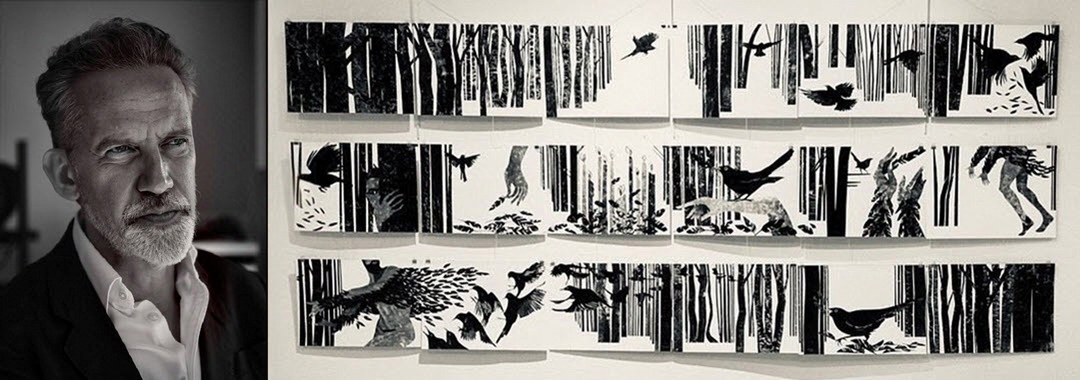
“I will always interpret a traditional myth of story
in my own way using contemporary references and context.”
Several years ago I came across the artwork of Stephen Richards on Instagram. What caught my eye was the vibrancy of his creative vision and the strength of his inkwork craftsmanship. Beyond that, I knew nothing and would just notice when he posted something.
In 2023, Richards posted about two works-in-progress: The Book of Icarus and The Seduction of Theseus, each a collage ink-and-wax-resist series of images based on the Greek myths.
During that time, I was writing Resolute Death, the first book of my Osley College mystery series. A key element in the setting is a small collection of ravens who inhabit the campus and figure occasionally as plot pointers and character touchstones. Ravens are the central motif in Richards’ Icarus. I bought a print from the work and hung it over my writing desk. Later, I asked him if I might use the image in the cover art for my novel and he most graciously agreed.
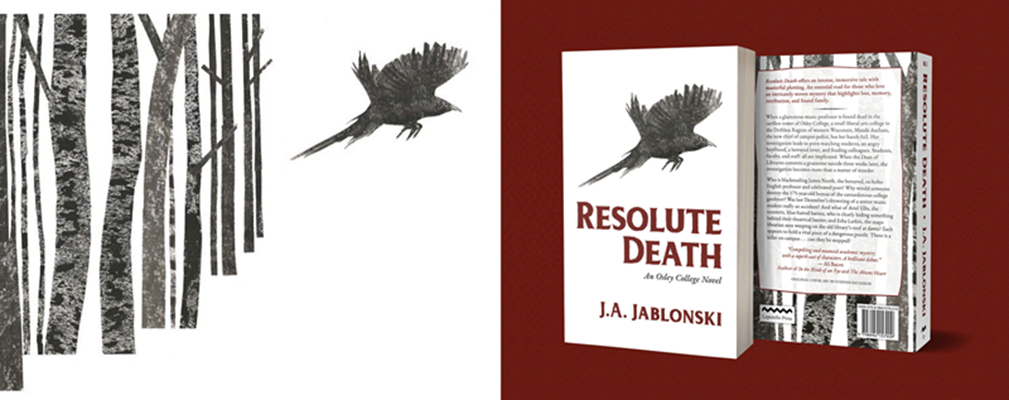
I was intrigued by his imaginative world and, wanting to hear more about his creative way of thinking and the practical logistics of what he does, I asked if we might engage in this interview-style, public conversation.
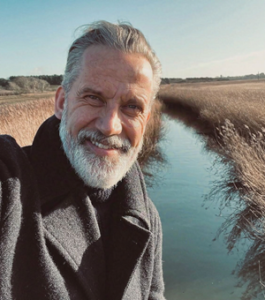 BIO
BIO
Stephen Richards, a leading landscape architect with over 30 years of award-winning international experience, is a London-based, Regional Partner and co-owner at the Gillespies architectural firm. [1] He studied at Heriot-Watt University in Edinburgh, majoring in landscape architecture. Richards is also a professional artist who specializes in working with mixed media, using wax resist and ink in combination with pencil to create textures to describe his narratives. He is particularly drawn to collage works where he cuts up previously prepared wax resist sheets to create representations of tree form and figures. He has explored many themes in his work from narrative stories, figure drawing, and portraiture.
GREECE
JAJ: I had a friend who was a travel agent, her favorite place to go was Greece. Several times in posts, you mention a trip you’d taken to the Greek island of Hydra. Clearly it was a time of both joy and inspiration. What draws you to Greece? What or how does this particular place speak to you?
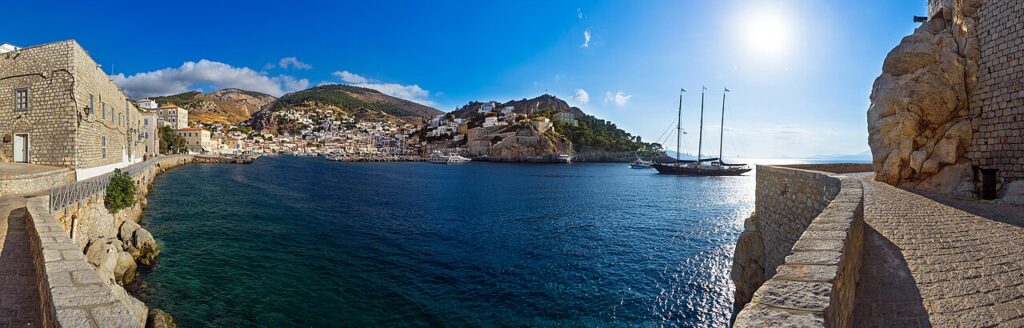
“Traditional settlement on the island of Hydra“
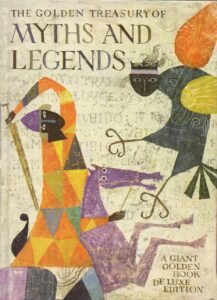
SR: My love of Greece, and in particular the Greek islands, stems from the illustrated books my parents gave me as a child and, in particular, the work of the great American illustrators Alice and Martin Provensen. In their Golden Treasury of Myths and Legends and their interpretation of Homer’s Iliad and Odyssey poems, they created beautiful depictions of the Greek countryside and Mediterranean Sea and filled them with depictions of petulant gods, lusty heroes and terrifying monsters. This world was exotic to me, so different from the genteel orchards and villages of my upbringing in Kent. Thus began a deeper fascination in this ancient world and other source material.
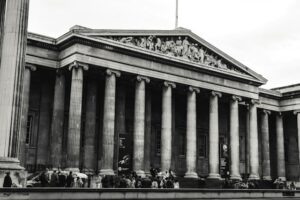 Early trips to the British Museum with my mother to see the Greek marble, bronze and ceramic remains held there further inspired my curiosity about the place they originated. I have since visited Greece on numerous occasions. For me, there is a spirit in the landscape, a tangible connection to this ancient society and their love of storytelling. I like to think some of the remoter islands haven’t changed much since their civilization and I was gazing on the same view as these ancient people would have done. I have since found out the landscape would have had far more tree cover than it does now. Perhaps I over romanticised my experience each time I visited, but that for me is an important part of the enjoyment and engagement. These places certainly spoke to me. Coming across fragments of temple remains and sculpture on walks across the islands were always thrilling and helped me conjure up the society and life of these people and their beliefs and pleasures.
The island of Hydra is particularly special place for me; I have stayed in a beautiful house there for a few years. It was a converted rope maker’s home with a lovely sequence of gardens and terraces that came into their own at different times of the day. The island itself is car free. You are woken each morning by the sound of donkeys delivering parcels and cockerels crowing across the valley. Its fame and notoriety stemmed from the 1960’s when is was a haven for musicians and travelers looking for unspoilt peace and tranquility. It now gets its fair share of tourist boats but you can still escape the crowds in the herb-filled pine forests.
Perhaps the most important thing Hydra has given me is a renewed interest in drawing. Each time I have been, I have taken ample supplies of drawing material and sketchbooks and filled my days, observing and drawing the place. My first concertina book was done there depicting the pine trees. Not long after I posted pictures of it, it was bought by a collector in Paris and I then knew I might be onto something both enjoyable and viable.If
MYTHOLOGY & MYTHMAKING
JAJ: In your artist’s statement, you note that “mythology features heavily in your life stemming from an early age.” [2] Were there particular stories that you enjoyed (or feared?). And adding to that, having created visual stories of certain myths, to what extent might you alter a traditional version or interpretation, do your own mythmaking as it were?
 SR: I realised quite young that I liked to be scared by the stories I read. It wasn’t so much an interest in destruction, conflict or war, it was more to do with the thrill of meeting mythical beasts in all their fantastical guises. I was drawn to these monsters and dark forces and the threats they posed to the order of things. I was equally drawn to those characters that faced up to them whether they were children my own age, who I could relate to, or dashing heroes I could look up to. Depictions were key to me especially in illustrated books and eventually film. But the written word always fired my imagination to create my own images in my mind.
My grandparents on my father’s side grew up in the west of England on the Welsh boarders where myths and storytelling abound, shaped by the extraordinary ancient and rugged landscapes there. My grandparents liked nothing better than to spook me with tales of a huge black dog that would roam the land at night bringing with it tragic misfortune, and wicked landowners with mysterious cellars in their mansions. I learnt to see these stories imprinted in the rocks and trees around their home, and in the wider landscape, the remoteness of the mist covered mountains, lonely buildings and the rapid streams, waterfalls and rivers.
I was very escapist as a child and would often lose myself in fantasy in these places, reading avidly and drawing maps and depictions of the creatures and people I had read about. I renamed all the streets and spaces in my home village where I was brought up so I could imagine a kingdom there and the mythology surrounding it. I particularly liked, and still do like, the darker side of fairy stories where wicked deeds are met by horrific comeuppances. It fed into my imagination that was on overdrive at the time.
As I have grown older and revisited these stories, I have quite naturally sought a more mature perspective, based on an increased understanding of the human condition. I am interested in how this has shaped these tales, how the beast is often a representation of powerful human emotions be they revenge, sexual desire, bereavement, hatred, hope and pure evil. The myths survive because they work at the level of a simple story or a more complex interplay. That is why I believe reinterpretation of myths is a quite legitimate exercise. Stories evolve as does the context in which they are set.
This drove me to reconsider the myth of Theseus and the Minotaur as a dance. I used flamenco as a vehicle in which to introduce the two protagonists, the beast perversely taking on the role of the matador, circling and confusing the young hero with his twists and turns, each time pulling him closer towards a seduction.
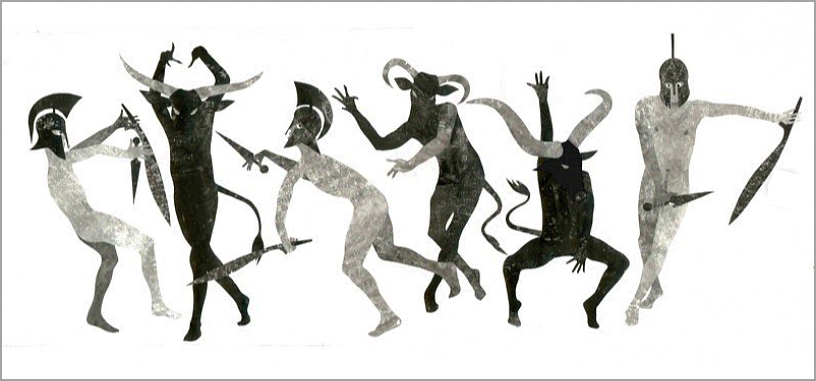
I will always interpret a traditional myth of story in my own way using contemporary references and context. The myth endures these changes because at its heart is a universal story of us, our weaknesses, strengths, hot-headedness and bravery.
My fascination with mythology fed into my early professional work as a landscape architect and helped me consider the deeper meaning behind the dense forests I designed, the lit glades, dark pools of water and gardens that I delivered. We project many meanings upon the landscapes around us, stemming from the stories we were told and inherited from our ancestors, and perhaps a deeper connection to place from prehistory when there was a great degree affinity with the natural world. In Europe there is a great tradition for fearing the forest as a place where good folk don’t belong, populated by beasts and cutthroats. The forest as setting for story telling holds a great deal of interest to me. y
FORMAT AND TECHNIQUE
 JAJ: In several of your Instagram images that are or have the flavor of landscape architecture, you’ve use the hashtag “PencilOnPaper” (or in an early reference, “#RotringPen”). In a 2024 LinkedIn post you commented “Representation by hand has always held a deep fascination for me since my early university days.” [3] Yet you work in a profession where the use of software such as AutoCAD LT is the norm. Has computer drafting impacted or changed your style or approach to hand-drawing?
S.R: I first entered the profession of landscape architecture because it appealed to my interests in both geography and drawing. As a student and young professional, drawing was the primary means of communicating an idea or mood. I was an avid researcher into the drawn outputs of other professionals and this helped me with my own style of depiction. My professional drawings were atmospheric, but primarily a means to describe a space or journey through a designed landscape. They were not fanciful or fantastical.
As my career developed, I spent less time drawing and the world of digital design took over my profession. I avoided using the software as my position didn’t demand it. It was during Covid that I rediscovered my love of drawing for drawings sake. My lockdown was in the Suffolk countryside and I was lucky because I could roam around without fear of encountering others. I started with depicting the trees around my home simply because I loved their forms, but also because of their age, steadfastness and dignity in a very troubled period of uncertainty and fear. I began to experiment more and use Instagram to post my drawings. The people I encountered there were immensely helpful in shaping my direction and added to the encouragement and support I received from home
I am very aware of digital impressions used in my professional sphere and I understand the speed with which complex spaces can be rendered quickly and effectively. I think there still is a place for drawing at the early stages of a project as it also looks more spontaneous, immediate and accessible and I certainly encourage my staff to adopt this approach.
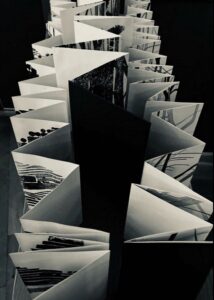 JAJ: While not the case for all of your work, several have employed a leporello (aka, concertina) format. How did you discover this approach? What is it about this format that works for or calls to you?
S.R: I was in my favourite art suppliers looking for pencils, ink and sketchbooks for my first trip to Hydra. I came across this folded book and it really took my fancy. I could immediately think of a long connected drawing. I bought a few and it proved really worthwhile, opening numerous possibilities for scroll drawings. I started with a study of pine trees, then a long fanciful illustration of the island itself. The scroll painting is a traditional technique in China and Japan for depicting an unfolding story on one long sheet of paper.
The French collector who bought the first one off me, called it a Leporello which comes from a character in Mozart’s Don Giovanni. He is on stage reading out all the names of his female encounters from a long folding sheet. I have since used them for other drawings where I like to continuation of a narrative linked by recurring motifs.
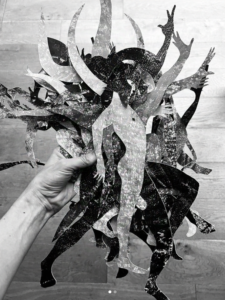 JAJ: Your collage work has an intense tactile quality to it. One of your IG posts shows you holding a handful of collage pieces, figures for your Minotaur work. Why and/or how does texture and shape work in your mind as you create?
S.R: I originally experimented with wax resist technique to depict sgraffito patterns in some ceramics I was drawing. I really liked the textures as the ink separated over the candle wax. I made up a number of f-sheets of varying weights of was and ink from pale grey to nearly black. As I studied them I saw how some of the textures resembled mottled skin and started to experiment using them in a collage technique. I’d draw the figure in pencil, trace and transfer sections onto the waxed paper and build up the collage. Varying the weight of the ink allowed me to represent shadow and form giving them a 3D effect. I also noticed how well the waxed paper resembled bark and this led onto a series of tree drawings. I still use wax but now mixed it with other mediums to create richly patinated effects.
COLOR
JAJ: Nearly all of the artwork, your own and others, displayed on your Instagram account are colored in shades of black, gray, and white. Often, though, your IG stories and posts about the art you view at various galleries and art shows or in books you’ve discovered, are filled with color. I’m not quite sure what I am asking here! Monochrome vs multicolored or multichromatic. What are you seeing/feeling/hearing in color or its lack? How does it speak to you?
S.R: I hugely enjoy seeing colour in other artists’ work. My father used bold colour in his commercial art a lot during the sixties as it was so much part of that scene and I grew up with his works and my parents colour sense in furnishings and fabric. Colour evokes intense pleasures and moods and I never look at a Matisse painting without feeling uplifted. However I genuinely struggle with colour in my own work. It takes great skill to understand colour associations and their impact. I would much rather focus on form, outline and texture. Currently I don’t see the need to experiment with colour but that could change as I evolve my practice.
TREES
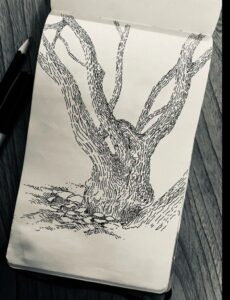 JAJ: Obviously, for a landscape architect, trees play an important role. But as an artist, trees and branches are often present in your non-portrait drawing. I am curious as to how trees function not only as objects of artistic study, but in the motivating vision or creative urge that underlies and inspires your work.
S.R: Trees feature greatly in my work. I am constantly struck by their peaceful, benign and immense scale, their musculature, signs of age, new life, decay and presence. I draw them in a similar way that I approach figure drawing – seeing them a living entity full of character with their flaws and personality. It’s important to me to try and express all those traits in a drawing. A challenge but one I hugely enjoy attempting.
I am also fascinated by depicting forests in my narrative works. Here I draw from the wealth of story telling from Northern Europe where the forest is seen as a dark place beyond the city walls, dense and tangled, a threat to order and stability, a haven for witches, beasts and those who would like to remain hidden. Now we understand them as hugely important ecosystems where a large variety of species are interconnected and sustained.
For me they are the perfect settings for the journeys and encounters I like to draw. The stems can conceal and reveal and I especially like them as a continuum, a constant motif especially in my leporello series. They help bind a story. I also enjoy the edges of woods and forests, how open space meets a dense wall of trees, a point departure, a conscious choice where you either stumble forward or carve your way in. Either way, you are entering a foreboding place and that’s a perfect foil for a drama to emerge.
INSPIRATION FROM OTHERS
JAJ: In your artist statement, you mention the creative support and inspiration of your parents. Who else has inspired you as an artist?
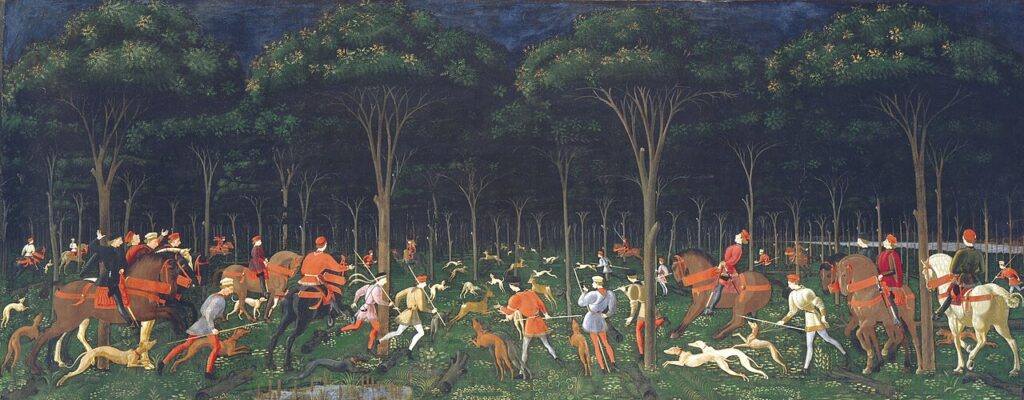
Paolo Uccello’s “The Hunt in the Forest”
SR: I am a real magpie when it comes to source material and have always enjoyed encountering imagery that opens my mind to potential new ideas. [4]
Childhood books: The work of Alice and Martin Provensen for their extraordinary Greek world; Pauline Baynes for the “Wood Between the Worlds,” in C.S. Lewis’ The Magician’s Nephew; Edward Ardizzone for Stig of the Dump and his wonderful depiction of an outsider in nature
Paintings: Paolo Uccello’s “The Hunt in the Forest” for the extraordinary depth of field; Keith Vaughan’s abstract landscapes; Graham Sutherland’s strange hedgerows; and Michael Aryton’s Minotaur and Icarus series in paintings, etchings and bronze.
Dancers: Sylvie Guillem, Alvin Ailey, Irek Mukhamedov, and Antonio Gades.
Films: Forbidden Planet, Jason and the Argonauts, and Cabaret.
THE BOOK OF ICARUS
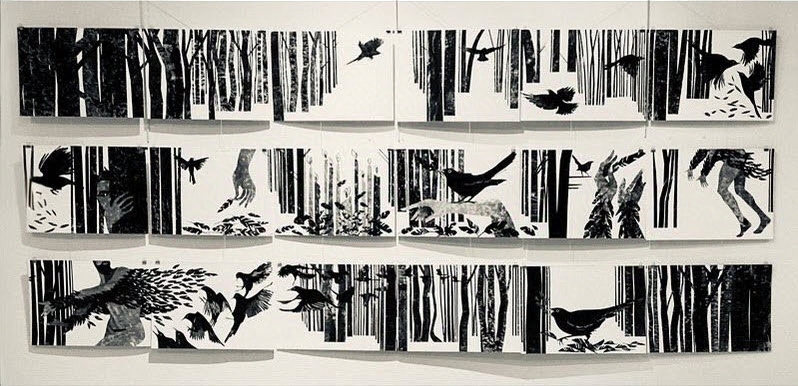
JAJ: There is something about that one image from your leporello work, I refer to it as “Raven Icarus,” that goes beyond storytelling for me. I mentioned to you at one point that, as I have synesthesia, I can feel this piece in my sternum when I look at it and “hear light” behind me. You mentioned to me that when creating it, you had a “strong sense of an agitated bird flying out from the safety of the forest to confront life.”
I asked about your mythmaking earlier. Could you talk about the narrative inspiration behind your telling of the Icarus myth.
SR: This work evolved over a period of a few months working mostly at the weekends and it slowly coming together within a large leporello. It started with me drawing birds in pencil and ink as a subject matter to test techniques and then moving onto feathers. I was using ink and wax resist and the thought occurred to me that feathers and wax was the basis of the Icarus tale and it would be a great medium to use. I wanted to make my own version set in a forest filled with birds.
The image you refer to is that exciting moment when a bird breaks cover and flies fast out of tree, nervous, agitated and usually calling loudly as it heads for another sheltered space. The birds’ home is the forest and there is a harmony and balance where they play out their lives. Enter Icarus, lost, depressed and alone. He sees the birds and is fascinated by their freedom and lightness. He decides there and then to become one and begins to collect their fallen feathers. Initially nervous of him, the birds soon help, bringing him feathers from throughout the forest. Icarus burns candles to collect wax with which he positions the feathers on his arms and back.
Intoxicated by the forest and its smells and light, he starts to dance and in his mind becomes a bird. This irritates the birds who don’t want to share their gift and flock to him from the depths of the forest and tear him apart. Collecting back the blood smeared feathers. So in this tale there is no direct reference to the Greek myth but still a tale of arrogance and disrupting the balance of nature with dire consequences
FUTURE WORK
JAJ: Do you have any plans any new narrative works?
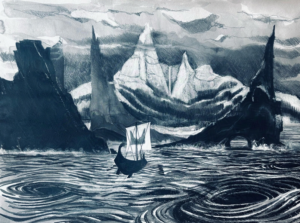
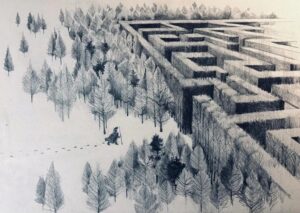
SR: Right now I am working on a new telling of the Minotaur myth set in the snowy north. I like forests in snow as a drawing theme and think the idea of a frozen labyrinth has potential. As we head into winter here the theme becomes richer and more appropriate to the landscapes around my home. I like Theseus sailing through the snowy wastes setting foot on a black island. As with all my work, there’s a sense of disruption to the natural order of things when man arrives on the scene.
This will be the case here too. As he gets closer to the island, the arctic wildlife become increasing agitated and noisy. I like this Theseus wrapped in furs and not the classic Greek nude. The Minotaur, too, is hairy and lives in a cave surrounded by prehistoric rock paintings. I do not know yet the full direction of this work and the outcome and that’s interesting for me as it allows me to flip and turn as I produce each panel.
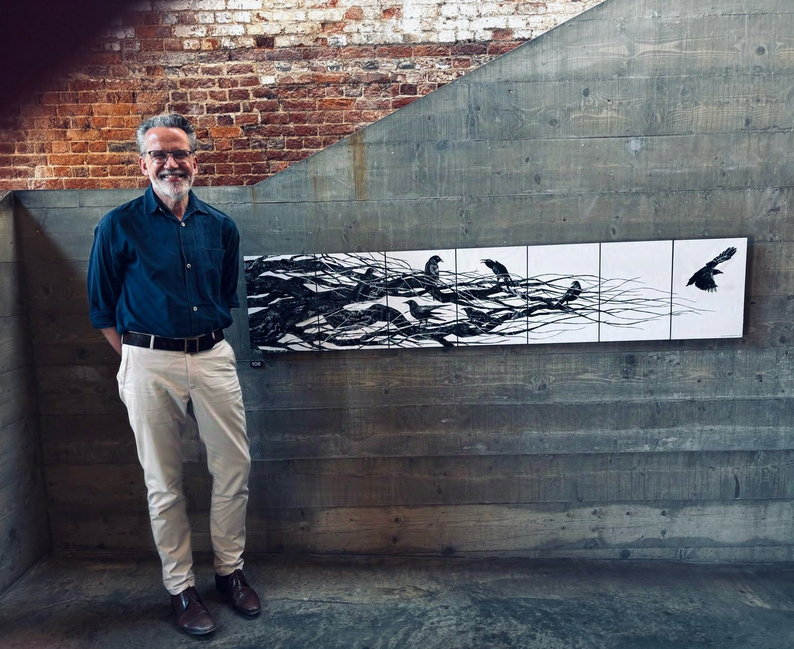
Stephen Richards can be found online at Instagram:
https://www.instagram.com/stephenrichards_drawing/
If you have a question or comment for me, drop me a line via my Contact page.
© J.A. Jablonski 2026. All rights reserved.
How to cite this post
Jablonski, J.A. (2026; Oct 12). Interview: Stephen Richards. Blog post. J.A. Jablonski (website).
https://jajablonski.com/2026/10/12/artist-stephen-richards/
IMAGE CREDITS
All black and white images (with the exception of the photo of the British Museum), the color self portrait, and the photo of Richards in the Britten Pears Arts gallery (Suffolk, UK) were provided by the artist and used with his permission.
- Main blog page image. Left: self-portrait at home. Right: home gallery display of works.
- Post header portrait of Stephen Richards by Stuart Alexander Carruthers.
- Double image. Left: a section of a page from The Book of Icarus. Right: my book Resolute Death employing the same page in its cover art design.
- Theseus and the Minotaur dancing.
- Pencil/ink drawing of Theseus approaching the Minotaur’s maze.
- Leporello art work example.
- Richards’ hand holding the cut-out collage pieces for eventual Theseus and the Minotaur work.
- Small sketchbook drawing of bare tree trunk.
- Leporello display of The Book of Icarus.
- Mixed media drawing of Theseus’ ship on the icy sea.
- Richards stands alongside his recent work “Conclave” in the Britten Pears Arts gallery.
Other:
- “Traditional settlement on the island of Hydra.” Photo by Violeta Meleti
SOURCES | NOTES
Quotation by Richards on the main page of my blog is from an essay he wrote for The Art Workers’ Guild: “Nature in a Time of Anxiety.” https://www.artworkersguild.org/blog/nature-in-a-time-of-anxiety-stephen-richards/, n.d.
[1] Gillespies. “Stephen Richards, Partner.” Accessed August 17, 2026. https://www.gillespies.co.uk/people/stephen-richards
[2] Artist statement: Stephen Richards, email message to author, August 7, 2026.
[3] Richards, Stephen. LinkedIn post, accessed June 4, 2026. https://www.linkedin.com/posts/stephen-richards-b8819412_drawing-sketchbook-activity-7098282165334863873-KWF-
[4] More on the creative inspiration artists that Richards mentions can be found here. The detail and quality of the information in these Wikipedia articles varies. Some, but not all, include links to collections that hold the artists’ work(s), exhibition catalogs, and external links to research articles and/or websites.
Writers
- Alice and Martin Provensen: https://en.wikipedia.org/wiki/Alice_and_Martin_Provensen
- Pauline Baynes: https://www.thewardrobedoor.com/p/the-magicians-nephew-chapter-3-the
and https://en.wikipedia.org/wiki/Pauline_Baynes - Edward Ardizzone: https://en.wikipedia.org/wiki/Edward_Ardizzone
and https://www.edward-ardizzone-archive.org/archive/stig-of-the-dump
Paintings
- Paolo Uccello: https://en.wikipedia.org/wiki/Paolo_Uccello
- Keith Vaughan: https://www.thekeithvaughansociety.com/ and https://en.wikipedia.org/wiki/Keith_Vaughan
- Graham Sutherland: https://en.wikipedia.org/wiki/Graham_Sutherland
and https://artuk.org/discover/stories/graham-sutherland-the-evolution-of-a-twentieth-century-master - Michael Aryton: https://en.wikipedia.org/wiki/Michael_Ayrton
Dancers
- Sylvie Guillem: https://artdeballet.org/who-is-sylvie-guillem/ and https://youtu.be/vx1-Ns-L70c
- Alvin Ailey: https://ailey.org/people/alvin-ailey and https://nmaahc.si.edu/alvin-ailey
- Irek Mukhamedov: https://en.wikipedia.org/wiki/Irek_Mukhamedov and https://www.gettyimages.com/photos/irek-mukhamedov; https://youtu.be/rQah4C7b5Gs and https://youtu.be/4AkuH5X-S9Y
- Antonio Gades: https://youtu.be/Db0XPbNeh7k and https://commons.wikimedia.org/wiki/File:Antonio_Gades_statue_in_Havana_Vieja.jpg

Films
- Forbidden Planet: https://en.wikipedia.org/wiki/Forbidden_Planet
- Jason and the Argonauts: https://en.wikipedia.org/wiki/Jason_and_the_Argonauts_(film)
- Cabaret: https://en.wikipedia.org/wiki/Cabaret_(1972_film)